
When Is Assisted Living Not Appropriate for a Parent With Dementia?

Assisted living may no longer be appropriate when a parent wanders, cannot follow basic safety directions, or needs more supervision than staff can provide. These are signs to assess whether memory care would be safer. A need for frequent skilled medical treatment or around-the-clock nursing points instead toward skilled nursing care. A dementia diagnosis alone does not settle the question; what matters is the help your parent needs each day.
If your parent is still safe with reliable support at home, moving may not be necessary yet. But if safety concerns are growing or family caregivers cannot keep up, ask for a care assessment before a crisis forces the decision.
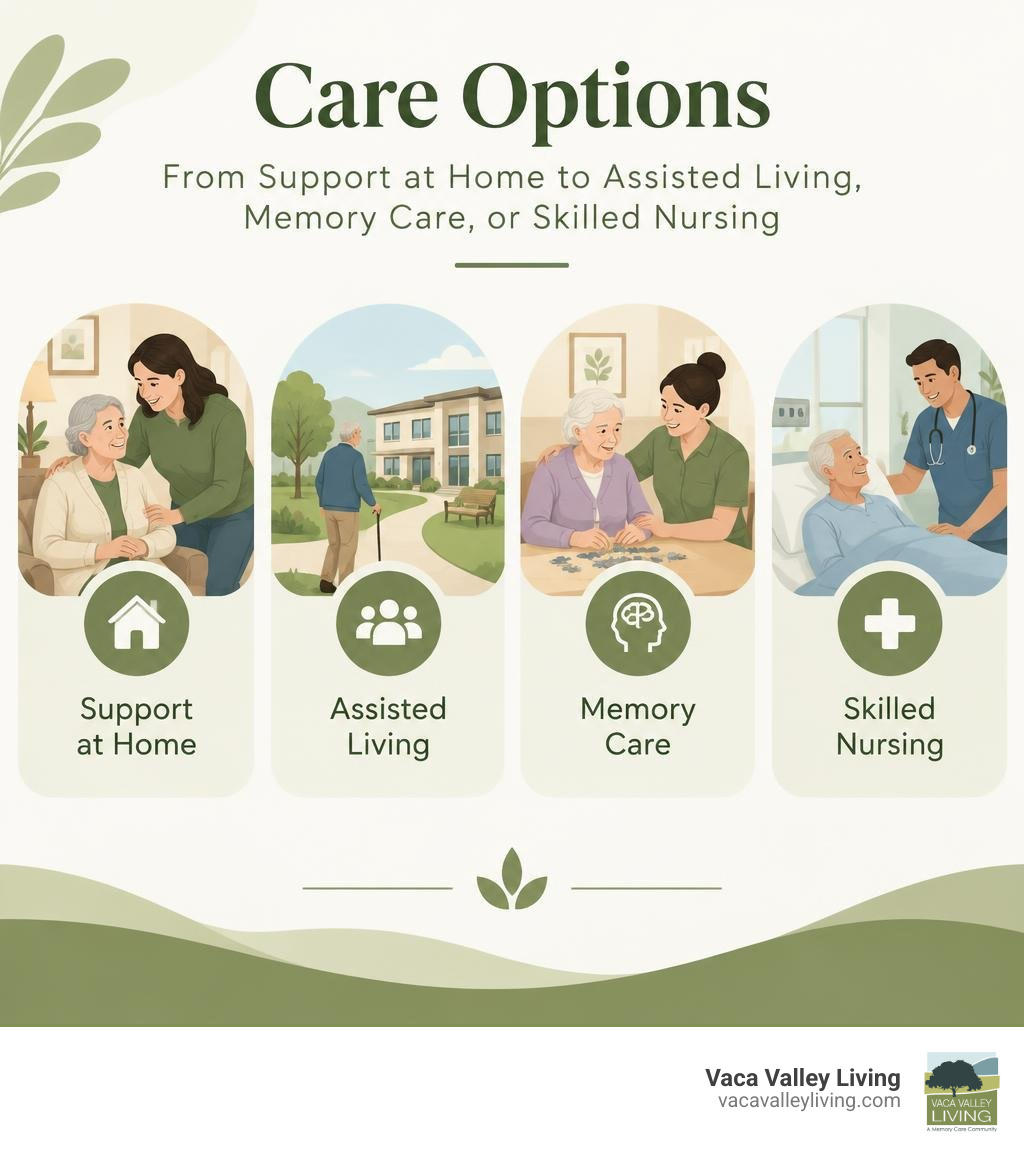
Clinical and Behavioral Factors: When Is Assisted Living Not Appropriate?
Navigating the senior care landscape often starts with a basic evaluation of daily needs. Standard assisted living bridges the gap between total independence and round-the-clock clinical care. These communities excel at helping older adults with Activities of Daily Living (ADLs)—such as dressing, bathing, medication reminders, and meal preparation. However, residential assisted living settings operate under specific licensing limits that define their scope of service.
According to established Elder Care Criteria & Senior Living Admissions guidelines, residential communities are built around predictable, scheduled assistance. When a resident's physical or cognitive needs escalate beyond periodic daily check-ins, a serious care mismatch occurs. Standard assisted living staffing ratios simply cannot accommodate continuous, unscheduled one-on-one supervision or intensive medical monitoring. Understanding when is assisted living not appropriate protects older adults from preventable accidents, emergency hospitalizations, and sudden displacement.
Medical Thresholds: When Is Assisted Living Not Appropriate for Complex Health Needs?
Assisted living communities are designed as social, residential environments rather than clinical facilities. While they employ trained caregivers and wellness directors, they do not function as hospital wards.
Assisted living is generally not appropriate when an individual develops:
- Extensive Wound Care Needs: Stage 3 or Stage 4 pressure ulcers requiring daily, sterile clinical dressing changes.
- Complex Medical Equipment Dependency: Active ventilators, tracheostomy care, or feeding tubes that require continuous medical oversight.
- Severe Medical Instability: Uncontrolled brittle diabetes with frequent, unpredictable hypoglycemic episodes requiring constant clinical adjustments.
- Total Immobility & Mechanical Lifts: Conditions where a resident is completely bedridden and requires two-person transfers or mechanical Hoyer lifts that exceed the facility’s staffing licenses.
- Need for 24/7 Skilled Clinical Monitoring: Acute post-surgical rehabilitation or progressive chronic illnesses that require continuous registered nurse (RN) supervision.
When round-the-clock clinical care is required, a skilled nursing facility (SNF) is the correct setting. While Medicare pays for up to 100 days of skilled nursing care per benefit period (covering the first 20 days in full and requiring a daily co-payment of $217 for days 21 through 100 in 2026), these services address short-term rehabilitation or intense clinical management rather than typical custodial care.
Cognitive Milestones: When Is Assisted Living Not Appropriate for Advancing Dementia?
Cognitive decline presents unique challenges that standard assisted living environments cannot safely accommodate. Over 70% of assisted living residents nationwide experience some degree of cognitive impairment. However, as conditions like Alzheimer’s disease, vascular dementia, or Lewy body dementia advance, safety thresholds are crossed.
The transition framework outlined in Assisted Living vs. Memory Care: Placement & Transition highlights key cognitive milestones indicating standard assisted living is no longer suitable:
- Exit-Seeking and Wandering: An individual who repeatedly attempts to leave the building, does not recognize environmental boundaries, or experiences acute disorientation.
- Sundowning and Sleep-Wake Inversion: Severe late-afternoon agitation, hallucinations, or nighttime pacing that poses personal safety hazards.
- Inability to Follow Emergency Directives: Failure to respond to fire alarms or follow basic evacuation commands during an emergency.
- Behavioral Distress and Resistance to Care: Physical or verbal aggression triggered by sensory overload or an inability to communicate basic physical needs.
Evaluating Non-Clinical Red Flags: Social, Psychological, and Relational Limits
Evaluating appropriate placement involves looking beyond medical charts. Emotional health, social engagement, and psychological well-being determine whether an environment supports a senior’s overall quality of life.
| Feature / Metric | Support at Home / Aging in Place | Standard Assisted Living | Specialized Memory Care |
|---|---|---|---|
| Primary Setting | Personal private residence | Residential community apartment | Secure, specialized neighborhood |
| Average Cost Structure | ~$232/day (Part-time to full-day aide) | ~$150 – $250/day base rates | Higher all-inclusive specialized rate |
| Staffing & Supervision | 1-on-1 during scheduled hours | 24-hour staff on call; scheduled ADL visits | 24-hour awake staff; low caregiver-to-resident ratio |
| Environmental Security | Standard door locks / home sensors | Open campus / standard entry & exit | Secure perimeters, keypads, anti-wandering tech |
| Dementia Programming | Informal / family directed | General social activities & outings | Sensory therapies, reminiscence, cue-based spaces |
Emotional Well-Being, Isolation, and Lost Autonomy
A major risk of keeping a cognitively declining adult in an open assisted living setting is progressive social withdrawal. When seniors struggle to follow multi-step conversations, keep track of meal times, or navigate large apartment hallways, they frequently retreat into their private rooms. This isolation often accelerates clinical depression and cognitive decline.
Conversely, forcing an older adult into residential assisted living when they require minimal physical help can compromise self-esteem and independence. Having a dedicated caregiver drop in at home to handle light housekeeping or meal prep may preserve dignity and routines far better than an unnecessary relocation.
Proximity to Family Support and Quality-of-Care Red Flags
Geographic location plays a massive role in placement success. When a community is located hours away from loved ones, family visits decrease, removing a crucial layer of emotional support and advocacy.
Facility quality is equally critical. Industry surveys indicate that up to 94% of long-term care facilities experience periodic staffing shortages. High turnover rates and understaffing lead to delayed response times, skipped baths, and unmanaged falls. Families across Northern California—including Solano, Yolo, and Contra Costa counties—rely on detailed resources like our senior care vacaville guide 2026 to vet community staffing stability and safety records before making a move.
Comparing Care Alternatives: Support at Home, Assisted Living, and Memory Care
Selecting the proper level of support requires balancing safety, autonomy, and financial realities. The clinical insights in Assisted Living or Memory Care for a Parent? show that care is most effective when delivered in the least restrictive environment possible.

Aging in Place vs. Residential Communities
Many families prefer to support aging in place for as long as possible. Making practical home modifications—such as installing shower grab bars, clearing trip hazards, and arranging meal deliveries—allows many seniors to thrive in familiar surroundings.
To determine if home remains viable, clinicians often use the "Three Areas" Test outlined in When Is It Time for Assisted Living? 25 Signs Your Elderly Parent May No Longer Be Safe at Home:
- Basic Needs: Can they reliably handle eating, personal hygiene, and toileting?
- Independent Living Tasks: Can they manage medication schedules, prepare simple meals, and track finances?
- Safety and Judgment: Can they recognize home hazards, avoid scams, and call for help during emergencies?
From a financial perspective, home care can be cost-effective for moderate needs (averaging approximately $232 per day for standard daytime coverage), whereas 24-hour nursing home care averages around $428 per day. However, when family caregiver burnout sets in and around-the-clock supervision becomes necessary, residential senior living vacaville ca communities provide a safer, more sustainable solution.
Assisted Living vs. Memory Care
When evaluating memory care versus standard assisted living, the primary differences lie in staff training, physical architecture, and daily structure:
- Architectural Design: Memory care environments use secure circular walkways that eliminate confusing dead-ends, visual landmarks, and color-coded corridors to assist with natural orientation.
- Staff Engagement: Care teams receive specialized training in dementia communication, reading non-verbal cues, and validating resident emotions rather than correcting them.
- Structured Engagement: Daily schedules emphasize sensory stimulation, music therapy, and calm routines designed to prevent overstimulation and sundowning.
While evaluating the dementia assisted living cost reveals that memory care carries a higher price point due to lower staffing ratios and enhanced security, the investment ensures comprehensive safety and purposeful engagement.
Navigating Discharge Notices, Resident Rights, and Planned Placement
Receiving an involuntary discharge notice from an assisted living facility can be an overwhelming experience for any family. As detailed in Help: My Mom Keeps Getting Kicked Out Of Assisted Living, these notices usually reflect an administrative care mismatch rather than a personal failure on the resident's part.
If your loved one is facing discharge, explore professional assisted living placement vacaville ca resources to identify memory care settings that welcome individuals with complex behavioral expressions.
Legal Protections and Discharge Procedures
Under state and federal guidelines, assisted living residents maintain explicit consumer rights:
- Written Notice Requirements: Facilities must generally provide at least 30 days of written notice prior to involuntary discharge, detailing the specific medical or behavioral reasons.
- Mandatory Assessments: Standard regulations require facilities to conduct initial assessments within 14 days of admission and at least annually thereafter (or immediately upon a significant functional change).
- Ombudsman Advocacy: Families have the legal right to engage their state Long-Term Care Ombudsman to review the discharge notice, contest improper evictions, and ensure safe discharge planning.
Action Steps for a Seamless Transition
Planning an intentional transition prevents emergency room visits and reduces relocation stress:
- Develop Personalized Care Plans: Work with clinicians to establish personalized care plans seniors need, documenting sleep patterns, personal history, favorite foods, and calming strategies.
- Conduct a Clinical Handoff: Ensure direct communication between the departing physician and the incoming wellness director to align medication management and dietary needs.
- Preserve Dignity and Familiar Comforts: Seek communities offering familiar lifestyle amenities—such as an assisted living with salon—to ensure personal pampering and familiar grooming routines remain uninterrupted.
Frequently Asked Questions About Senior Care Transitions
What medical conditions immediately disqualify someone from assisted living?
Assisted living is generally disqualified when a person requires round-the-clock clinical registered nursing care. Disqualifying conditions include Stage 3 or 4 pressure wounds, permanent ventilator dependence, active infectious conditions requiring airborne isolation, nasogastric feeding tubes, total immobility requiring two-person mechanical transfers, or severe, unmanaged medical instability.
How do memory care environments handle exit-seeking behaviors differently than assisted living?
Unlike standard assisted living communities that feature open entrances, memory care communities incorporate secure perimeters, keyless coded entryways, and enclosed garden courtyards. They also utilize environmental cues—such as mural-camouflaged exit doors, circular indoor walking paths, and sensory calming areas—to gently redirect wandering impulses without using physical or chemical restraints.
What rights do families have if a facility issues an involuntary discharge notice?
Families have the right to receive a formal 30-day written notice explaining the exact clinical or safety reasons for discharge. You have the right to request a formal care conference, review all daily charting and incident logs, appeal the discharge decision through the regional Long-Term Care Ombudsman, and demand that the facility cooperate in developing a safe, orderly transition plan.
Conclusion
Recognizing when assisted living is no longer suitable is an act of proactive care, not defeat. When an aging parent's needs outgrow standard residential care, moving to specialized memory care protects their safety, eases caregiver distress, and restores daily comfort.
At Vaca Valley Living in Vacaville, California, our family-owned community brings over 50 years of dedicated experience to residential memory care. We provide 24-hour specialized staffing, individual care routines, and a warm, home-like neighborhood for seniors navigating Alzheimer’s and dementia across Solano, Yolo, Napa, and surrounding Northern California communities. If you are noticing changes in your loved one's safety, discover specialized residential memory care designed around dignity, comfort, and peace of mind.