Memory Care vs Skilled Nursing What Every Family Needs to Know
Memory Care and Skilled Nursing: The Key Difference

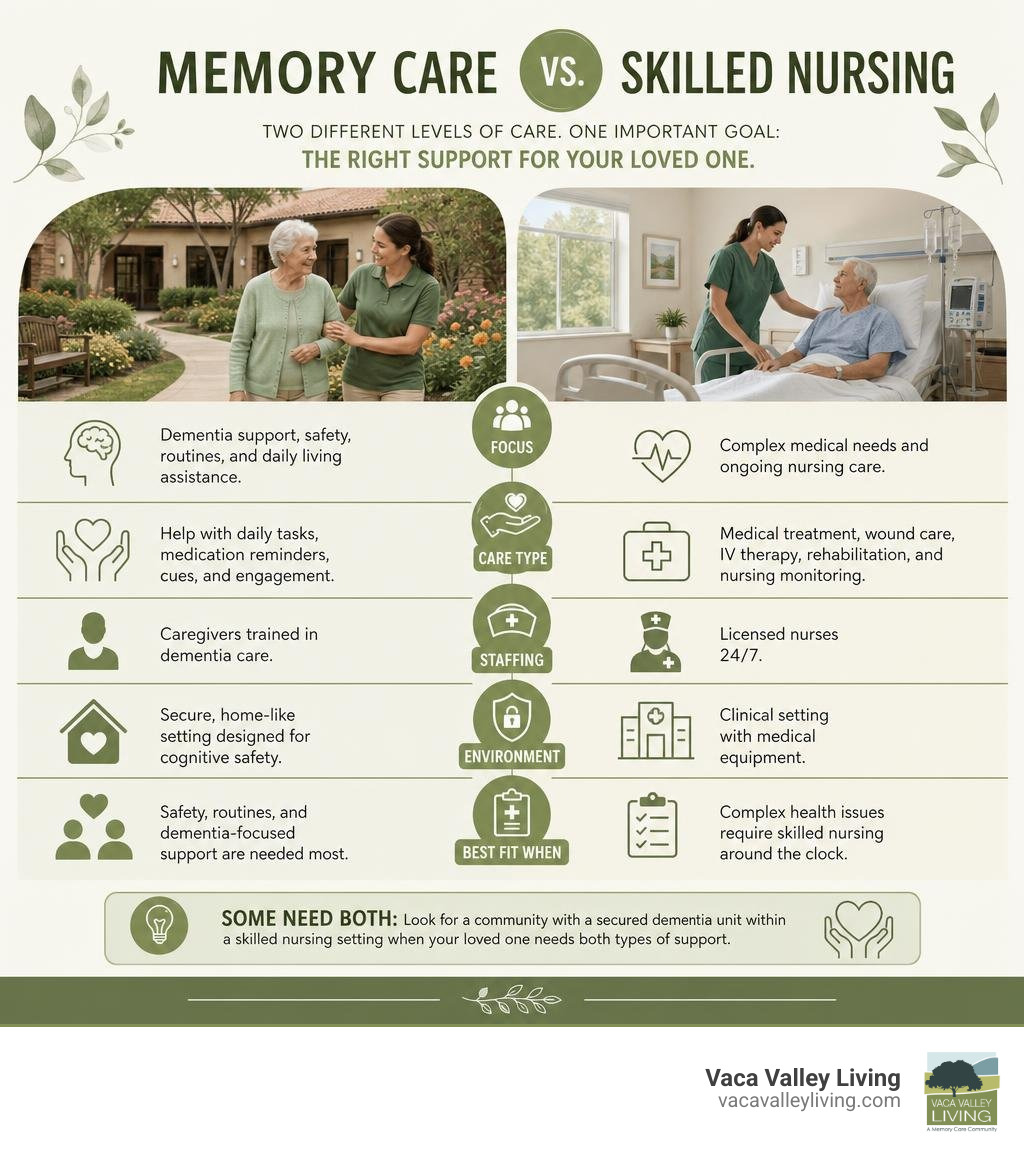
No, memory care is not usually considered skilled nursing. Memory care is designed for people with Alzheimer's disease or other dementias who need a secure setting, daily support, and staff who understand memory loss. Skilled nursing provides a higher level of medical care, such as wound treatment, IV therapy, rehabilitation, and ongoing nursing monitoring.
The simplest way to choose is to focus on your loved one's medical needs, not only the stage of dementia:
- Choose memory care when safety, routines, help with daily tasks, and dementia-focused support are the main needs.
- Consider skilled nursing when complex medical issues require licensed nursing care around the clock.
- Look for a community with a secured dementia unit within a skilled nursing setting if your loved one needs both types of support.
A person can have advanced dementia and still be a good fit for memory care if their health is medically stable. But a new pressure injury, feeding tube, major mobility loss, repeated falls, or frequent hospital visits may signal that skilled nursing is now needed.
This guide explains the differences in care, staffing, costs, insurance coverage, and the signs that it may be time to consider a change.
Is Memory Care Considered Skilled Nursing? Core Legal and Medical Differences
When families ask, "is memory care considered skilled nursing?", the legal and operational answer is straightforward: no. They are distinct types of residential senior care governed by completely different regulatory frameworks, clinical mandates, and licensing bodies.
Memory care is classified under state-level residential care or assisted living regulations. Its primary mission is to deliver custodial care—hands-on assistance with activities of daily living (ADLs) such as dressing, bathing, dining, and medication reminders—within an environment purpose-built for cognitive safety.
In contrast, skilled nursing facilities (SNFs), commonly referred to as nursing homes, are medical institutions. They are federally certified through the Centers for Medicare & Medicaid Services (CMS) under Title 18 (Medicare) and Title 19 (Medicaid) of the Social Security Act, in addition to holding state Department of Public Health licenses. SNFs provide 24/7 clinical supervision, physical rehabilitation, and invasive medical treatments ordered directly by a physician.
Understanding the legal differences between memory care and skilled nursing helps clarify why insurance pays for one setting but rarely covers the other. As outlined in detailed analyses of is memory care considered skilled nursing, the distinction hinges on medical necessity versus supportive custodial supervision.
Is Memory Care Considered Skilled Nursing in Assisted Living Settings?
In most states, memory care exists as a specialized, secured branch of assisted living. These residential communities cater specifically to individuals living with Alzheimer's, vascular dementia, Lewy body dementia, and frontotemporal disorders.
Dedicated Alzheimer's care facilities focus heavily on cognitive engagement, structured daily routines, and behavioral validation rather than acute medical interventions. Residents in these settings are medically stable, meaning they do not require daily intravenous medications, intensive respiratory therapy, or surgical wound management. The emphasis remains on quality of life, emotional dignity, and home-like comfort.
What Skilled Nursing Facilities Provide That Memory Care Does Not
Skilled nursing facilities are designed to handle complex, fluctuating medical conditions that non-medical residential communities are legally and operationally unable to accept.
Services unique to skilled nursing facilities include:
- Complex wound care (such as stage 3 or 4 pressure ulcer management).
- Intravenous (IV) medications, fluids, and total parenteral nutrition (TPN).
- Feeding tube administration (PEG tubes) and specialized enteral nutrition management.
- Daily physical, occupational, and speech therapy aimed at post-acute recovery.
- Tracheostomy care and continuous respiratory management.
- Continuous clinical assessment by Registered Nurses (RNs) and Licensed Practical Nurses (LPNs).
Comparing Daily Care, Staffing, and Facility Environments
The everyday experience in a memory care community feels dramatically different from that of a skilled nursing facility. Memory care emphasizes warmth, community connection, and personal independence within safe boundaries, whereas a skilled nursing facility operates closer to a specialized hospital wing.
In memory care, an assisted living caregiver works closely with residents throughout the day, providing compassionate guidance through bathing, meal choices, and social activities. These caregivers receive specialized training in dementia communication, redirection techniques, and recognizing non-verbal signs of discomfort.
| Feature / Metric | Memory Care Community | Skilled Nursing Facility (SNF) |
|---|---|---|
| Primary Care Focus | Cognitive support, safety, ADL help, dignity | Clinical recovery, complex medical care, 24/7 nursing |
| Licensing & Oversight | State Department of Social Services / Assisted Living | Federal (CMS) & State Department of Public Health |
| Staffing Model | Certified caregivers, med techs, memory coordinators | 24/7 RNs, LPNs/LVNs, Certified Nursing Assistants (CNAs) |
| Living Environment | Residential, private/semi-private suites, secured gardens | Clinical, hospital-like, semi-private/private rooms |
| Average Monthly Cost (2026) | $6,450 – $7,899 (median range) | $9,277 (semi-private) – $10,646+ (private) |
| Medicare Coverage | Does not cover room & board (covers therapies/doctors) | Covers up to 100 days post-hospitalization |
| Medicaid Coverage | Limited (select HCBS state waivers only) | Broad coverage for long-term clinical stays |
Specialized Dementia Environments vs. Clinical Medical Settings
Memory care architecture is tailored to reduce disorientation and calm sensory overload. Communities incorporate circular walking paths, secure enclosed courtyards, color-coded hallways, and gentle acoustic environments. These design elements actively minimize wandering hazards and alleviate agitation associated with sundowning.
When families ask what stage is aggression in dementia, the answer often points to the middle-to-late stages, when frustration and sensory confusion peak. Memory care teams use specialized behavioral de-escalation, sensory rooms, music therapy, and customized amenities like on-site salons, activity lounges, and dining rooms to maintain comfort without relying heavily on sedative medications.
Skilled nursing environments, by comparison, prioritize clinical efficiency. You will see nurse stations with telemetry monitors, wide corridors suited for hospital stretchers, and specialized medical equipment readily accessible.
Can a Person Receive Memory Care and Skilled Nursing at the Same Time?
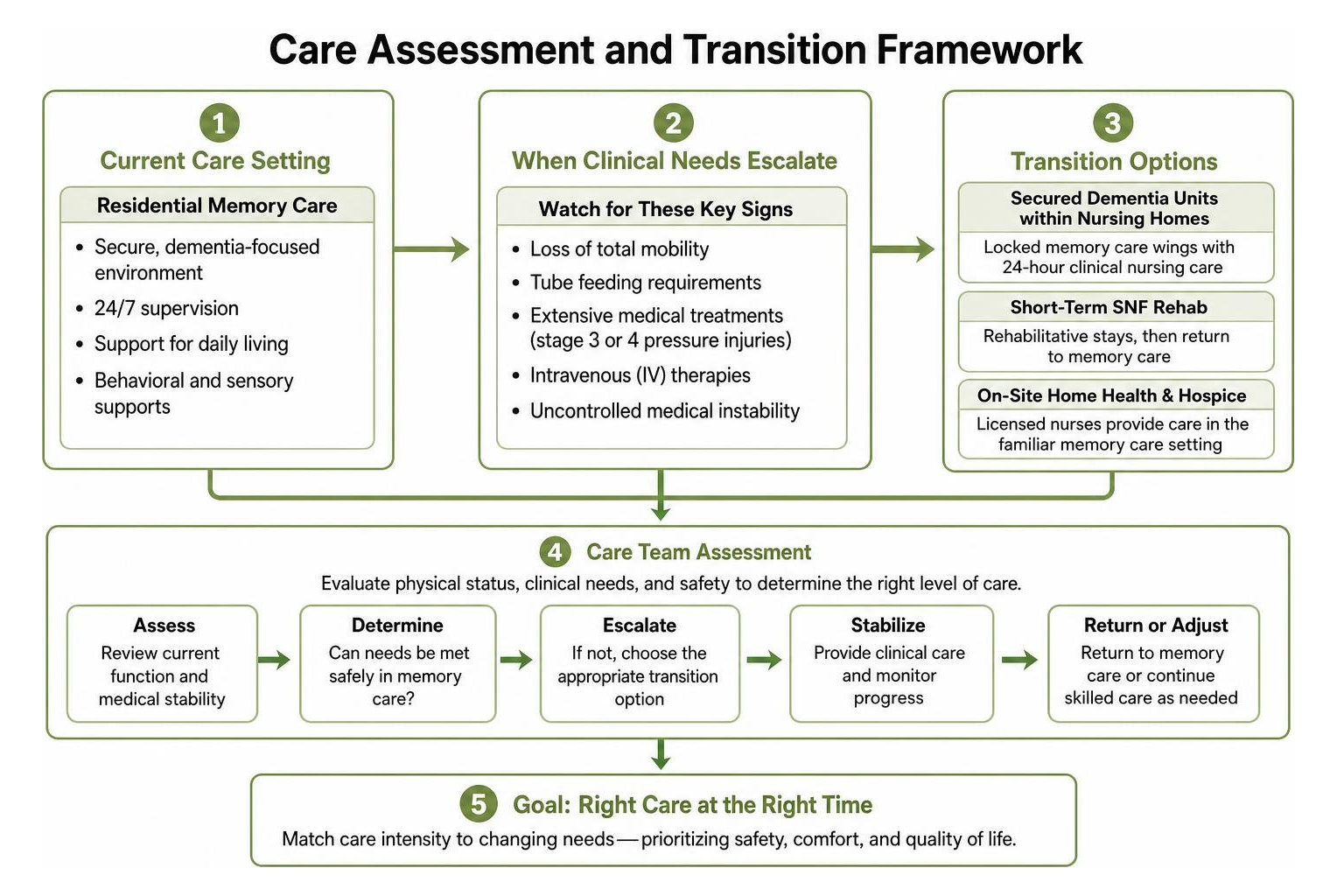
Yes, under certain circumstances. A senior can receive both memory care and skilled nursing through dedicated hybrid settings or short-term rehabilitative stays:
- Secured Dementia Units within Nursing Homes: Approximately 15% of nursing homes maintain dedicated memory care wings. These wings feature locked perimeters and dementia-trained staff while delivering full 24-hour clinical nursing care.
- Short-Term SNF Rehab with a Return to Memory Care: A resident living in memory care who fractures a hip can temporarily transfer to a skilled nursing facility for post-surgical rehabilitation and wound therapy, returning home to their memory care community once their condition stabilizes.
- On-Site Home Health & Hospice: Many memory care communities coordinate with third-party home health or hospice agencies, allowing licensed nurses to provide wound checks or palliative care while the senior remains in their familiar memory care suite.
State-specific regulatory guides illustrate how these settings compare in practice, such as the framework for memory care vs nursing homes in California, as well as comparative rules in Massachusetts and Arkansas.
When to Transition: Signs a Loved One Needs Skilled Nursing
Dementia is a progressive condition, but advancing cognitive loss does not automatically require a nursing home move. The decision to transition from residential memory care to a skilled nursing facility is almost always triggered by escalating physical and clinical demands.
Key signs that a transition to skilled nursing is needed include:
- Loss of Total Mobility: Becoming completely bedbound and requiring two-person mechanical lifts for every transfer.
- Tube Feeding Requirements: The need for total nasogastric (NG) or percutaneous endoscopic gastrostomy (PEG) feeding tubes.
- Extensive Medical Treatments: Developing stage 3 or stage 4 pressure injuries that demand daily surgical dressings and clinical debridement.
- Intravenous (IV) Therapies: Requiring ongoing IV antibiotics or frequent medication adjustments via clinical infusions.
- Uncontrolled Medical Instability: Frequent, unpredictable medical crises resulting in repeated emergency room visits and hospital admissions.
Is Memory Care Considered Skilled Nursing When Managing Dementia Progression?
Even in late-stage dementia, if a loved one can still safely swallow pureed food, transfer with the help of one caregiver, and remain medically stable, residential memory care often remains the most comforting option.
During earlier stages, community resources like Alzheimer's day programs provide daytime respite and cognitive structure before full-time placement becomes necessary. When late-stage dementia brings natural physiological decline, many families choose to introduce hospice care directly inside the memory care community, avoiding the clinical disruption of a hospital-style nursing facility.
Costs, Medicare, and Medicaid: Financial Breakdown for 2026
Financing long-term senior care requires an understanding of how care levels dictate payment structures. Because memory care is classified as supportive residential housing, it is predominantly funded through private assets, whereas skilled nursing relies heavily on government healthcare programs.
According to data compiled from the National Investment Center for Seniors Housing & Care (NIC) and national long-term care reports:
- Memory Care: The national median cost averages between $6,450 and $7,899 per month (roughly $77,400 to $94,788 annually), depending on location and individual care tiers.
- Skilled Nursing Facility: A semi-private room averages $9,277 per month ($111,324 annually), while a private room averages $10,646 to $11,300 per month (exceeding $127,000 annually).
Medicare Coverage Limits for Skilled Nursing vs. Memory Care
A common misconception is that Medicare pays for long-term dementia care. Medicare does not cover the room and board costs of memory care or long-term nursing homes. Medicare is designed strictly for acute medical care and short-term post-hospital rehabilitation.
For skilled nursing, Medicare Part A provides limited, conditional coverage under specific rules:
- The 3-Day Inpatient Rule: The beneficiary must have a qualifying inpatient hospital stay of at least three consecutive days (observation status does not count).
- Timing: Admission to the SNF must occur within 30 days of the hospital discharge.
- The 100-Day Benefit Period:
- Days 1–20: Medicare covers 100% of approved costs.
- Days 21–100: The patient pays a daily coinsurance rate (over $200 per day in 2026).
- Day 101 and beyond: Medicare pays $0. All costs become the responsibility of the family or Medicaid.
Families researching local clinical options often search for nursing homes that accept Medicare near me when their loved one requires short-term rehabilitative care following a hospital discharge.
Medicaid and Long-Term Financial Support Options
Medicaid serves as the nation's primary safety net for long-term institutional nursing care. For seniors who meet strict financial eligibility thresholds (typically under $2,000 in countable assets for an individual in 2026), Medicaid covers room, board, and clinical care in certified nursing homes.
Federal spousal impoverishment rules allow the non-applicant spouse (the community spouse) to protect a portion of combined assets (up to $162,660 in 2026) along with a monthly maintenance needs allowance.
For memory care, traditional Medicaid does not pay room and board. However, many states offer Home and Community-Based Services (HCBS) waiver programs (such as California's Assisted Living Waiver) that provide financial subsidies for personal care services within approved assisted living and memory care communities.
Frequently Asked Questions About Memory Care and Skilled Nursing
Do dementia patients do better in memory care or a nursing home?
Individuals living with dementia generally experience better behavioral and emotional outcomes in dedicated memory care communities, provided they are medically stable. Memory care facilities offer homelike environments, sensory stimulation, and higher staff-to-resident ratios focused on communication and reassurance.
A skilled nursing facility is the better choice when physical ailments (such as tracheostomies, non-healing surgical wounds, or total feeding assistance) require around-the-clock medical attention from licensed nurses.
How much does memory care cost compared to a nursing home in 2026?
On average, memory care costs between $6,450 and $7,899 per month, while a semi-private room in a skilled nursing facility runs $9,277 per month and a private room exceeds $10,646 to $11,300 per month.
Memory care facilities typically use tiered pricing models based on the level of assistance required for ADLs, while skilled nursing rates reflect comprehensive 24/7 medical and nursing oversight.
Are memory care expenses tax-deductible?
Yes. Under IRS Code Section 213 and IRS Publication 502, long-term care expenses that exceed 7.5% of an individual's Adjusted Gross Income (AGI) can be deducted as qualified medical expenses.
If a licensed physician certifies that a resident requires continuous supervision due to severe cognitive impairment (such as Alzheimer's disease) as part of a prescribed plan of care, the entire cost of memory care—including room and board—may qualify as a tax-deductible medical expense. Always consult a certified tax professional or elder law attorney to confirm eligibility.
Making the Right Care Choice for Your Family
Selecting the right care setting for an aging loved one is one of the most consequential decisions your family will ever make. It begins with an honest assessment of daily medical needs versus cognitive and behavioral requirements.
When your family member is medically stable but needs a secure, engaging environment with compassionate personal care, residential memory care offers the warmth and dignity of a true home.
At Vaca Valley Living in Vacaville, California, our family-owned community brings over 50 years of senior care experience to creating individualized, supportive environments for individuals with Alzheimer's and dementia. We invite you to explore specialized memory care options and learn more about our dedicated team as you navigate the next step in your loved one's journey.