Financial Assistance Programs That Help Families Afford Dementia Care
Government Programs Offering Dementia Care Financial Assistance

Families seeking dementia care financial assistance can draw on several key programs: Medicaid Home and Community-Based Services (HCBS) waivers and institutional long-term care, Medicare’s GUIDE respite model, Social Security Disability Insurance (SSDI) and Supplemental Security Income (SSI), and VA Aid and Attendance benefits. Private options such as long-term care insurance, life insurance conversions, and home equity strategies can fill remaining gaps. Understanding how each program functions—and where its boundaries lie—is essential to unlocking available funds.
Medicare and the GUIDE Respite Care Model
Original Medicare (Parts A and B) provides broad health coverage for adults 65 and older, covering hospitalizations, physician visits, cognitive assessments, physical therapy, and hospice care. Medicare Part D assists with prescription medications.
However, Medicare comes with a major limitation: it does not pay for non-skilled, custodial long-term care or residential memory care room and board. Medicare Part A only covers short-term rehabilitation in a skilled nursing facility (up to 100 days following a qualifying three-day inpatient hospital stay) when daily skilled nursing or therapy is medically required. Many families wonder is memory care considered skilled nursing; while skilled nursing involves continuous medical intervention, memory care focuses on specialized cognitive support, daily personal care, and safety supervision.
To address caregiving gaps, the Centers for Medicare & Medicaid Services launched the GUIDE Model overview (Guiding an Improved Dementia Experience). This initiative delivers care coordination, 24/7 support lines, and direct caregiver relief. Under the GUIDE dementia respite benefit analysis, qualifying beneficiaries enrolled in Original Medicare Parts A and B who live at home with an unpaid primary caregiver can access up to $2,625 per year in government-funded respite services for the 2026–2027 performance year.
GUIDE respite is billed directly by participating providers at set standard rates:
- In-Home Respite: $138 per 4-hour unit
- Adult Day Care: $104 per daily session
- Facility-Based Respite: $321 per 24-hour overnight stay
Beneficiaries pay zero out-of-pocket costs for approved GUIDE respite up to the annual cap. Individuals enrolled in Medicare Advantage, PACE, or hospice are not eligible for GUIDE respite.
Medicaid Coverage, Spend-Down Rules, and HCBS Waivers
Medicaid is a joint federal and state program that represents the largest single payer of long-term care services in the nation. Unlike Medicare, Medicaid covers long-term institutional nursing care as well as personal care services through Home and Community-Based Services (HCBS) waiver programs.
Eligibility requires meeting strict clinical and financial criteria:
- Income Thresholds: In 2026, the standard federal baseline income limit for long-term care Medicaid is $2,982 per month for an individual (or $5,964 for married couples applying together).
- Asset Limits: An applicant cannot hold more than $2,000 in countable liquid assets ($3,000 for couples). Countable assets include checking accounts, savings, stocks, and secondary real estate. Exempt assets generally include a primary home (up to statutory equity limits if a spouse resides there), one vehicle, and prepaid funeral trusts.
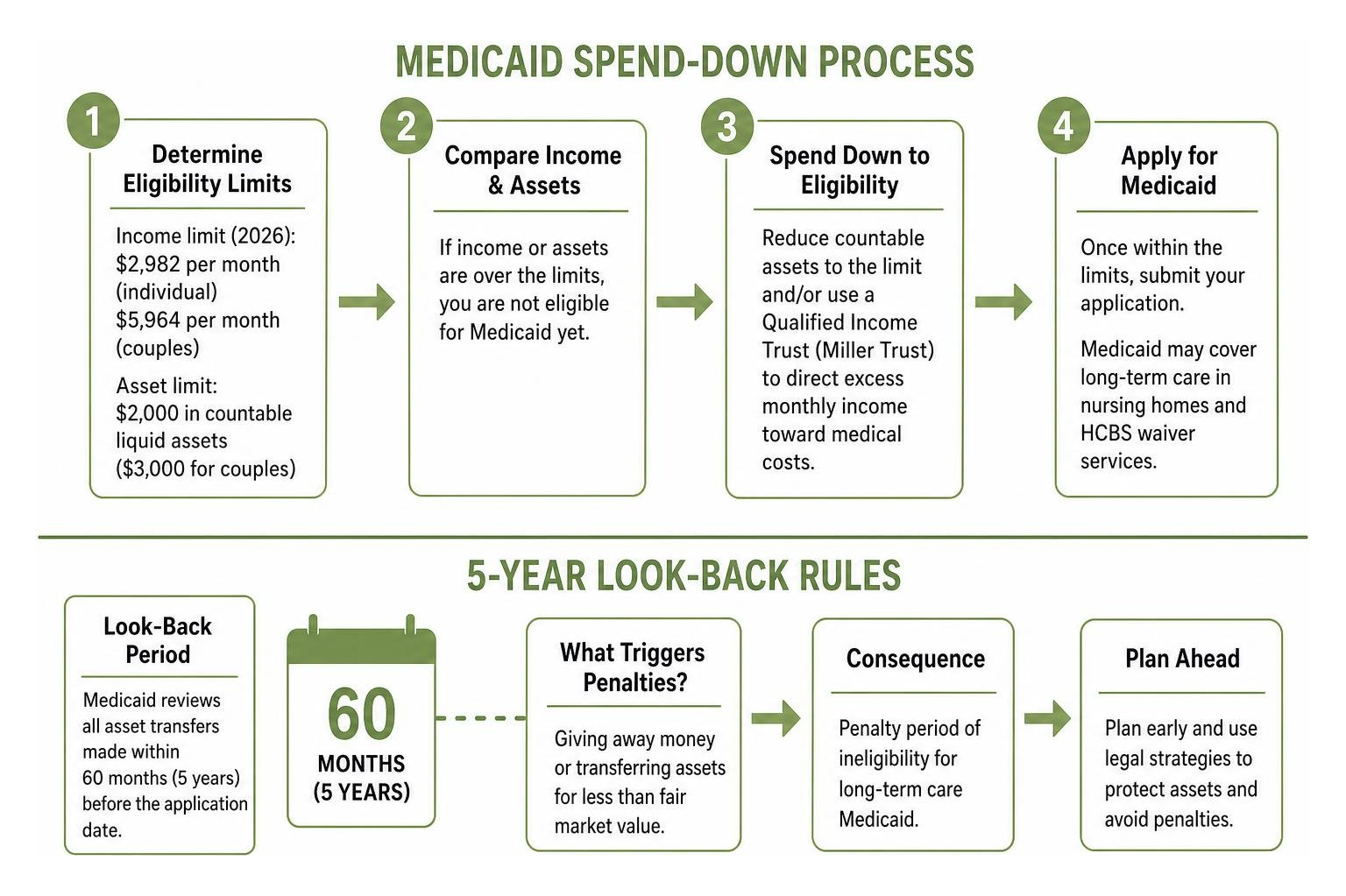
When reviewing applications, Medicaid applies a strict 5-year look-back period to examine all asset transfers. Giving away money or selling property below fair market value within 60 months of applying can trigger substantial penalty periods of ineligibility.
If income or assets exceed standard limits, families often utilize legal "spend-down" strategies or establish Qualified Income Trusts (Miller Trusts) to direct excess monthly income toward medical costs. Detailed guidance on Medicaid dementia coverage and income limits helps clarify how states administer these waivers. Families evaluating facility settings can also review our comprehensive memory care skilled nursing guide.
Social Security Disability (SSDI), Compassionate Allowances, and SSI
For individuals diagnosed with younger-onset Alzheimer’s or frontotemporal dementia before age 65, federal disability programs provide vital income replacement:
- Social Security Disability Insurance (SSDI): Based on the worker’s accumulated work credits, the average SSDI benefit is $1,960 per month in 2026. Through the Social Security Administration's Compassionate Allowances Initiative, individuals diagnosed with early-onset dementia receive expedited review, reducing claim processing times from months to mere weeks. SSDI recipients also qualify for Medicare coverage after a 24-month waiting period.
- Supplemental Security Income (SSI): A needs-based program for low-income seniors aged 65+ or disabled individuals. In 2026, the maximum federal SSI payment is $994 per month for an individual. SSI eligibility requires holding less than $2,000 in countable resources and automatically qualifies recipients for Medicaid coverage in most states.
Veterans Benefits: VA Pension and Aid and Attendance
The Department of Veterans Affairs offers exceptional monthly financial support for wartime veterans and their surviving spouses through the VA Aid and Attendance enhanced pension program. This benefit is specifically designed for veterans who require assistance with activities of daily living (ADLs)—such as bathing, dressing, eating, or managing safety in a memory-care environment.
In 2026, maximum monthly Aid and Attendance benefit rates include:
- Single Veteran: Up to $2,424 per month (tax-free)
- Surviving Spouse: Up to $1,558 per month (tax-free)
- Married Veteran: Up to $2,875 per month (tax-free)
To qualify, the veteran must have served at least 90 days of active duty with at least one day during an officially recognized wartime period, have received an honorable discharge, meet net-worth caps, and submit a formal medical rating detailing cognitive or functional impairment.
Private Funding and Asset-Based Strategies for Memory Care

Because public programs rarely cover 100% of assisted living or dedicated memory-care room and board, families rely on private resources, asset reorganization, and insurance to fund high-quality care.
Long-Term Care Insurance and Life Insurance Conversions
If a policy was purchased prior to cognitive symptoms appearing, traditional long-term care (LTC) insurance provides dependable monthly reimbursements. Most policies carry an elimination period (typically 30 to 90 days of out-of-pocket care) before daily benefit maximums activate. Always consult the Alzheimer's insurance guidance to ensure your policy's cognitive impairment triggers and inflation riders are properly leveraged.
If no LTC policy exists, life insurance policies can be converted into immediate cash:
- Accelerated Death Benefits (ADB): Many whole and universal life policies include riders allowing policyholders to access 50% to 80% of the death benefit early if certified with a chronic or terminal condition.
- Life Settlements & Viatical Settlements: Selling an unneeded policy to a licensed third party for an immediate lump-sum cash settlement, which typically yields substantially more than the policy's surrender value.
- 1035 Exchanges: Tax-free exchanges of a life insurance policy's cash value into an eligible hybrid annuity or long-term care instrument.
Utilizing Home Equity, Reverse Mortgages, and Bridge Loans
For many older adults, home equity represents their largest financial asset. Converting that equity can cover years of memory care:
- Outright Property Sale: Liquidating a primary residence generates immediate capital to fund residential care communities.
- Home Equity Conversion Mortgages (HECM): A federally insured reverse mortgage available to homeowners age 62 and older. It allows a senior (or their spouse living at home) to borrow against equity tax-free without monthly mortgage repayments. The loan is settled when the home is eventually sold.
- Senior Living Bridge Loans: Short-term, lines-of-credit designed to pay upfront memory care entrance fees and monthly rents while the family waits for a home sale to close or a VA Aid and Attendance claim to finalize.
Early-Onset Dementia Workplace Benefits and Retirement Accounts
When dementia affects an individual who is still employed, taking strategic steps through human resources protects earned benefits:
- COBRA Continuation: Extends group medical coverage for 18 to 36 months following employment separation.
- Short-Term & Long-Term Disability (STD/LTD): Replaces 50% to 70% of pre-disability wages. LTD policies should always be claimed prior to resigning.
- Tax-Advantaged Accounts: Flexible Spending Accounts (FSAs) and Health Savings Accounts (HSAs) allow families to save 20% to 30% in pretax dollars on eligible out-of-pocket medical supplies, prescription costs, and adaptive equipment.
- Penalty-Free Early Retirement Access: Under IRS Section 72(t), individuals certified as permanently disabled can take early distributions from traditional 401(k)s and IRAs before age 59½ without incurring the customary 10% early withdrawal tax penalty.
Pairing these income strategies with structured dementia care plans ensures financial decisions directly align with the person's anticipated medical and personal needs over time.
State and Community-Based Relief Programs
Federal aid is only half the equation. State agencies and local nonprofit networks provide direct caregiver relief, micro-grants, and daily care services.
State-Level and Community Dementia Care Financial Assistance Programs
State Departments of Aging coordinate local programs designed to keep seniors supported in least-restrictive environments. In California, the California Department of Aging Alzheimer's support network coordinates diagnostic centers, specialized behavioral training, and respite care.
Another vital public support model is PACE (Program of All-Inclusive Care for the Elderly). PACE coordinates primary care, therapy, medications, and adult day healthcare for dual-eligible (Medicare and Medicaid) seniors, allowing them to receive comprehensive daytime support at zero out-of-pocket cost. In Solano County and adjacent Northern California communities, accessing local dementia support services through regional caregiver networks can substantially lower daily caregiving costs.
Area Agencies on Aging, Respite Vouchers, and Local Grants
Local Area Agencies on Aging (AAAs) operate as single points of entry under the national "No Wrong Door" framework. AAAs administer:
- Lifespan Respite Care Programs: Periodic local respite vouchers (often ranging from $500 to $1,500) that reimburse families for hiring temporary home health aides or funding short adult day stays.
- Nutrition & Transportation Assistance: Free or sliding-scale Meals on Wheels delivery and non-emergency medical van transport.
- Caregiver Assistance Funds: Private donor-funded grants (such as regional caregiver stipends) designed to reimburse emergency respite and essential medical supplies.
Budgeting Strategies: How to Layer Payment Sources
Because memory care costs average $6,690 per month nationwide, relying on one single income stream is rarely sustainable. Successful families combine multiple revenue streams into a unified monthly budget.
| Funding Category | Common Sources | Average Monthly Contribution (2026) | Primary Purpose / Coverage |
|---|---|---|---|
| Social Security & Pensions | SS Retirement, SSDI, Employer Pensions | $1,960 – $2,071+ | Base monthly rent and routine living expenses |
| Veterans Benefits | VA Aid and Attendance Pension | $1,558 – $2,424 | Memory care room, board, and personal assistance |
| Insurance Policies | Long-Term Care Insurance, Life Conversions | $1,500 – $4,000 | Daily personal care, cognitive supervision, medications |
| Private Assets & Equity | Reverse Mortgages, Home Sales, 401(k)/IRA | Variable ($1,000 – $5,000+) | Bridging gaps between income and monthly care fees |
| Government Respite & Grants | Medicare GUIDE, State Respite Vouchers | $500 – $2,625 / year | Planned caregiver breaks and short-term relief |
How to Combine Private Assets with Dementia Care Financial Assistance
Building an enduring budget begins with a complete asset inventory:
- Lock in Guaranteed Incomes: Aggregate monthly Social Security benefits, military pensions, and annuity payments.
- Layer Targeted Veterans or State Benefits: Apply early for VA Aid and Attendance or local HCBS supports.
- Structure Asset Spend-Down: Draw systematically from investment accounts or home equity lines to cover the remaining balance. Review comprehensive Alzheimer's Association financial planning resources and consult an elder law attorney to establish a durable power of attorney and healthcare directives before cognitive capacity declines.
Transitioning to Residential Memory Care
As dementia advances from moderate to severe stages, around-the-clock safety supervision becomes essential. Wandering risks, medication management needs, and physical fatigue often make home care unsustainable for family caregivers.

When home is no longer safe, moving into a dedicated memory care setting provides 24-hour trained staffing, secured courtyard access, structured cognitive engagement, and chef-prepared nutrition. Facilities develop personalized care plans for seniors that adapt as cognitive and physical needs evolve.
When evaluating residential Alzheimers care facilities, families should tour communities to evaluate staff-to-resident ratios, sensory engagement therapies, and security features. Choosing an experienced, dedicated dementia care community guarantees your loved one receives compassionate, specialized attention tailored to their unique life story.
Frequently Asked Questions About Dementia Care Financial Assistance
Does Medicare pay for residential memory care communities?
No. Medicare Parts A and B do not pay for the room, board, or non-skilled custodial personal care provided in residential memory care or assisted living communities. Medicare continues to pay for covered medical expenses, doctor visits, hospitalizations, hospice care, physical therapy, and prescription medications (under Part D) while living in a community, but the residential care fees remain the family's financial responsibility.
What is the maximum monthly benefit for VA Aid and Attendance in 2026?
In 2026, a single qualifying wartime veteran can receive up to $2,424 per month, a surviving spouse can receive up to $1,558 per month, and a married veteran with a dependent spouse can receive up to $2,875 per month in tax-free pension benefits. Applicants must prove medical need for daily assistance with activities of daily living (such as bathing, dressing, or cognitive safety monitoring).
How do families protect assets while qualifying for Medicaid long-term care?
Asset protection requires planning around Medicaid’s 5-year look-back period. Allowable strategies include spending down funds on non-countable assets (such as paying off existing debt, making home safety modifications, purchasing an exempt vehicle, or establishing irrevocable prepaid burial trusts), establishing Miller Trusts for excess monthly income, and utilizing spousal impoverishment provisions that let the healthy spouse retain a Community Spouse Resource Allowance (CSRA). Always consult an accredited elder law attorney before transferring any assets.
Conclusion: Building a Sustainable Care Plan
Affording quality dementia care requires an early, multi-layered financial strategy. By combining Social Security benefits, VA Aid and Attendance, Medicare respite opportunities, private retirement funds, and community resources, families can ensure their loved ones receive continuous, dignified support without exhausting family savings.
At Vaca Valley Living, we understand the emotional and financial complexity of Alzheimer’s and dementia care. As a family-owned community with over 50 years of senior care experience, our Vacaville, California community provides a warm, home-like environment featuring 24-hour specialized staffing, individualized daily care routines, an on-site salon, and secure, scenic grounds.
We invite families across Solano, Yolo, Napa, and Contra Costa counties to discover how our compassionate team can support your journey. Reach out to our care team today with your questions, schedule a tour of our beautiful neighborhood, or explore our specialized residential memory care services directly at Vaca Valley Living.