
Early Onset Dementia Care: A Practical Roadmap for Caregivers
A Practical First Step in Early Onset Dementia Care

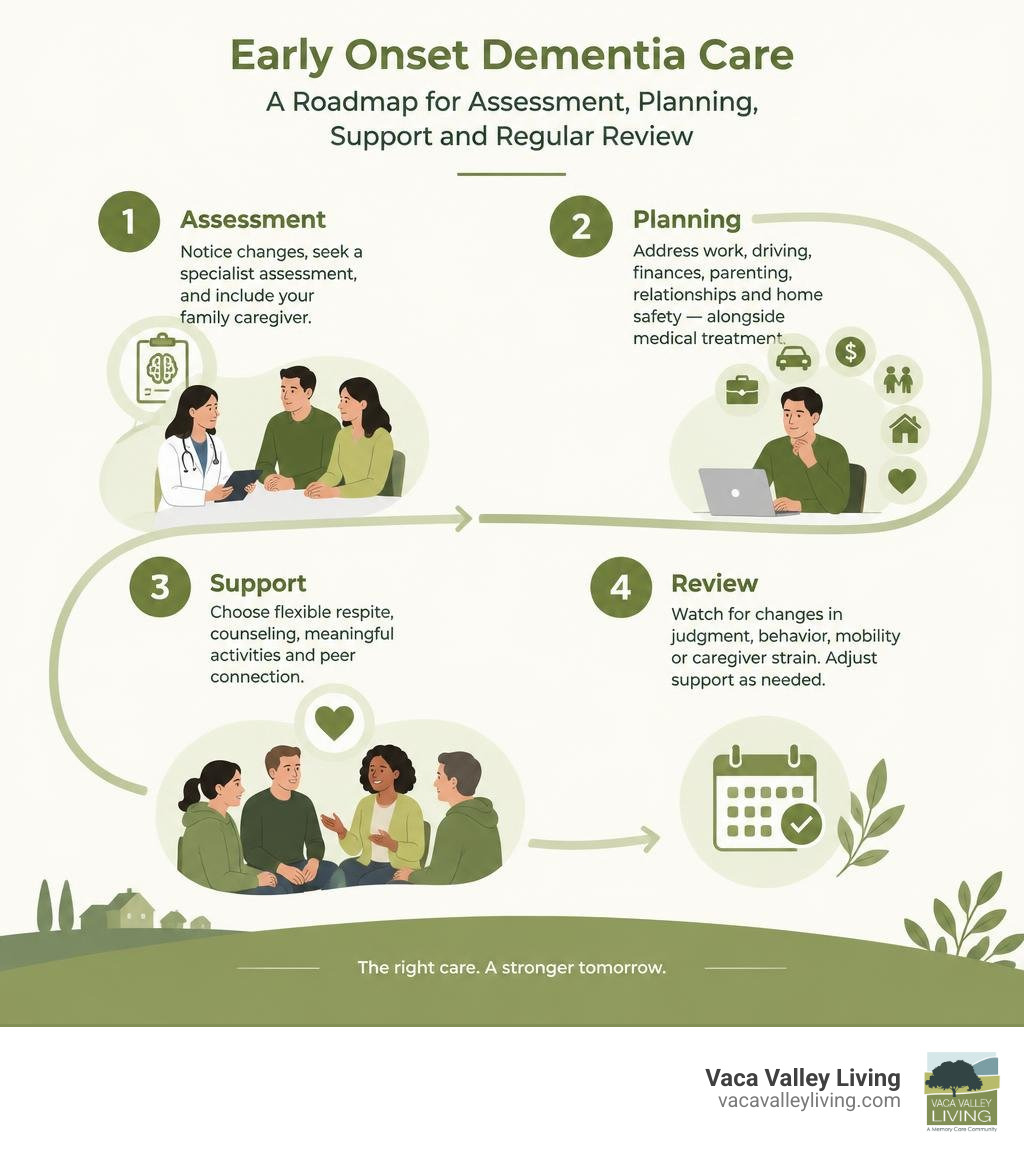
Early onset dementia care works best when families act early, build a care team, and choose support that fits a working-age adult's life. Start by documenting changes in thinking, behavior, language, work performance, or daily safety. Ask for a specialist assessment if concerns continue, and include the family caregiver in every care-planning conversation.
- Seek a thorough diagnosis. Symptoms may look like stress, depression, burnout, or relationship problems at first. A specialist evaluation can help rule out reversible causes and identify the type of dementia.
- Plan around real life. Address work, driving, finances, parenting, relationships, and home safety alongside medical treatment.
- Ask for age-appropriate support. Younger people with dementia and their caregivers often need flexible respite, counseling, meaningful activities, and peer connection - not services built only for frail older adults.
- Review needs regularly. Changes in judgment, behavior, mobility, or caregiver strain can signal that more in-home help or a secure memory care setting is needed.
Early onset, also called young-onset, dementia refers to dementia diagnosed before age 65. It is less common than later-onset dementia, but its effects can be especially disruptive because people may still be employed, raising children, managing a household, or caring for aging parents.
Diagnosis can take years, and research suggests that 30% to 50% of younger people may initially receive a wrong diagnosis. That delay can leave families feeling isolated and unprepared. Compassionate, relationship-centred care helps protect what matters: safety, routine, identity, purpose, and connection between the person living with dementia and the people who love them.
Understanding Early-Onset Dementia: Symptoms, Causes, and Diagnostic Realities
Early-onset dementia (affecting individuals aged 18 to 64) is an umbrella term encompassing neurodegenerative conditions that emerge during what are typically peak productive years. The incidence of young-onset dementia is estimated at 11 to 13.4 per 100,000 persons, with total prevalence rates doubling every five years between ages 30 and 64. In the United States alone, between 220,000 and 640,000 individuals live with this diagnosis.
Unlike late-onset Alzheimer’s disease, which predominantly manifests as episodic memory loss, younger presentations frequently present atypically. Conditions such as frontotemporal dementia (FTD), vascular dementia, early-stage neurological disorders, and familial Alzheimer’s disease often first alter executive functioning, speech patterns, spatial judgment, and personality before basic memory declines.
Understanding the causes and clinical presentation of early onset dementia is critical for identifying why younger adults face diagnostic delays averaging 3 to 5 years. While about 10% of young-onset cases have a direct hereditary genetic link, other factors include microvascular damage, traumatic brain injuries, and rare metabolic conditions.
| Clinical Feature | Early-Onset Dementia (<65 Years) | Late-Onset Dementia (65+ Years) |
|---|---|---|
| Typical Age of Presentation | 30 to 64 years old | 65 to 85+ years old |
| Initial Symptoms | Executive dysfunction, language deficits, personality shifts, mood changes | Short-term episodic memory loss, repetitive questioning |
| Common Etiologies | Familial Alzheimer’s, Frontotemporal Dementia (FTD), Vascular Dementia | Sporadic Alzheimer’s disease, Mixed Dementia, Lewy Body Dementia |
| Diagnostic Timeframe | Often delayed 3 to 5 years; high misdiagnosis rate (30–50%) | Typically diagnosed within 1 to 2 years of onset |
| Hereditary Likelihood | ~10% linked to autosomal dominant or genetic mutations | Predominantly multifactorial and non-familial (<1–2% genetic) |
| Primary Life Disruptions | Loss of career, dependent children at home, severe financial strain | Retirement adjustments, co-morbid physical frailty |
Overcoming Diagnostic Barriers in Early Onset Dementia Care
Because dementia is widely stereotyped as an older person's condition, primary care clinicians frequently attribute early cognitive changes to midlife crises, clinical depression, chronic anxiety, or corporate burnout. Approximately 60% of younger individuals experiencing mild cognitive impairment remain undiagnosed, and those who receive a formal evaluation frequently endure extensive delays.
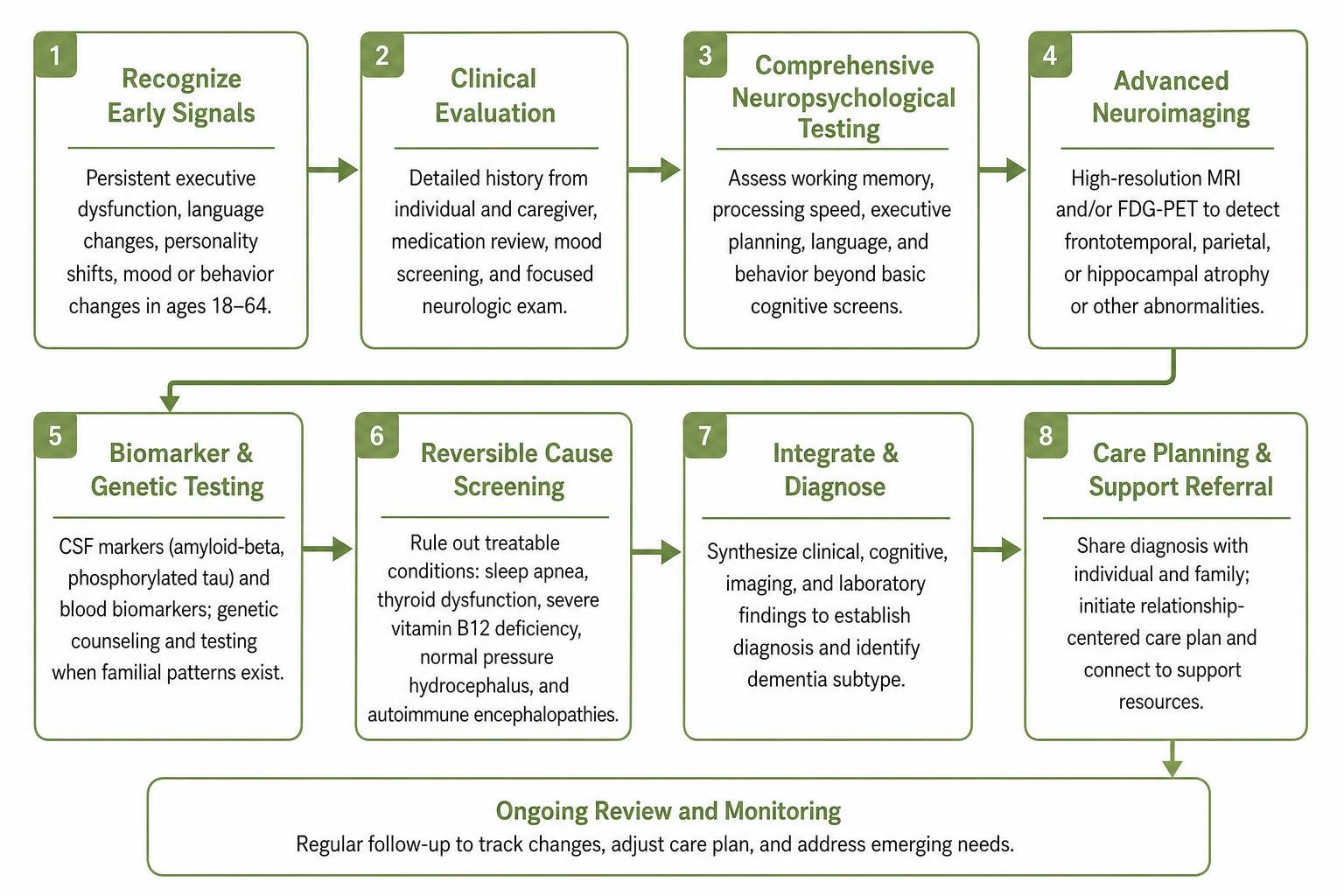
Overcoming these barriers requires an aggressive diagnostic workup when persistent executive or behavioral changes occur:
- Comprehensive Neuropsychological Testing: Pinpointing deficits in working memory, processing speed, and executive planning rather than relying solely on basic mini-mental status exams.
- Advanced Neuroimaging: Utilizing high-resolution structural MRI and FDG-PET imaging to detect localized frontotemporal, parietal, or hippocampal atrophy.
- Biomarker and Genetic Testing: Evaluating cerebrospinal fluid (CSF) markers (such as amyloid-beta and phosphorylated tau) and blood biomarkers, alongside genetic counseling where familial patterns exist.
- Reversible Cause Screening: Ruling out obstructive sleep apnea, thyroid dysfunction, severe vitamin B12 deficiencies, normal pressure hydrocephalus, and autoimmune encephalopathies.
Developing a Relationship-Centred Early Onset Dementia Care Plan
A diagnosis of young-onset dementia triggers what sociologists term "biographical disruption"—an abrupt derailment of long-term career goals, marital roles, parenting duties, and retirement plans. Traditional person-centred care models sometimes focus exclusively on the individual patient, but younger adults require a relationship-centred care model.
In young-onset scenarios, care involves an interconnected dyad—the individual and their primary partner or family caregiver. Establishing personalized care plans ensures that residual cognitive and physical abilities are emphasized, sustaining personal dignity rather than merely focusing on deficits (Nwadiugwu, 2021).
Applying the Senses Framework to Daily Support
According to published research on relationship-centred dementia care, applying Mike Nolan’s Senses Framework creates a shared, supportive environment where both the individual with dementia and their caregiver experience six fundamental psychological states:
- A Sense of Security: Feeling safe from physical harm, emotional humiliation, and financial ruin. For the caregiver, this means access to clear, timely medical guidance and dependable respite.
- A Sense of Belonging: Maintaining authentic connections with family, friends, and peer groups rather than facing isolation due to cognitive changes.
- A Sense of Continuity: Bridging the past and present by maintaining beloved family traditions, personal values, and favorite hobbies with appropriate adaptations.
- A Sense of Purpose: Engaging in goal-directed, structured daily routines that make the individual feel needed and active.
- A Sense of Achievement: Celebrating everyday victories—whether completing an adapted art project, gardening, or assisting with dinner preparation.
- A Sense of Significance: Recognizing that one's personal identity, feelings, and voice remain valued despite the progression of cognitive impairment.
Non-Pharmacological Strategies and Behavioral Interventions
Non-pharmacological interventions form the cornerstone of behavior management in early-onset dementia, substantially reducing reliance on sedating psychotropic medications.
- Montessori-Based Activities: Engaging individuals in tactile, structured activities that break tasks into manageable steps. This leverages intact procedural memory (e.g., sorting tools, arranging floral displays, baking with measured ingredients).
- Adapted Psychotherapy and Talking Therapy: Individual and couples counseling during early stages helps process grief, manage reactive depression, and build proactive coping strategies.
- Managing Behavioral Shifts: Progressive neurodegeneration may occasionally cause frustration or agitation. Understanding what stage aggression occurs in dementia helps caregivers identify environmental triggers, reduce overstimulation, and use validation therapy rather than direct confrontation.
- Structured Sensory Calming: Implementing predictable daily schedules, calming lighting, and music therapy to mitigate late-afternoon confusion and restlessness.
Navigating Workplace, Financial, and Community Support Systems

The economic impact of early-onset dementia is distinct and immediate. Unlike retirees, younger adults are frequently forced out of the workforce during their peak earning years. In surveys conducted by the Alzheimer’s Association, nearly half of working-age individuals with early-onset dementia reported being fired, demoted, or forced into early retirement before obtaining an accurate diagnosis. Furthermore, roughly 14% of patients under age 59 leave their employment within twelve months of receiving an initial diagnosis.
The financial strain extends heavily to family partners. A scoping review on spousal caregiver navigation highlights that family partners spend an average of 30 hours per week providing informal care, frequently cutting their own work hours or resigning entirely (Bøtchiær & Kristensen, 2025). Across the United States, uncompensated primary caregiving accounts for an estimated $159 to $215 billion annually.
Proactively coordinating specialized dementia support services is critical for securing:
- Employer Benefits and Accommodations: Applying for short-term and long-term disability benefits (LTD), Family and Medical Leave Act (FMLA) protections, and Social Security Disability Insurance (SSDI) under Compassionate Allowances guidelines.
- Legal Directives: Establishing durable power of attorney for healthcare and finances, updating living wills, and creating revocable living trusts while the individual retains legal decision-making capacity.
- Personal Care Budgets: Reviewing local waivers, private insurance policies, and veteran benefits to offset the out-of-pocket costs of specialized in-home assistance.
Mitigating Community Marginalization and Service Gaps
A primary barrier in young-onset dementia care is systemic ageism in reverse: community adult day centers and social programs are frequently geared toward frail, non-ambulatory seniors in their 80s. A mixed-method study revealed that 66.3% of young-onset dementia participants declined community services because the offerings did not match their physical stamina, interests, or age bracket.
Overcoming this marginalization requires seeking programs that cater to younger, active adults. Modern models emphasize nature walks, athletic clubs, volunteer activities, and dedicated support groups tailored to younger adults with mild symptoms.
Specialized Respite and Long-Term Residential Solutions
As young-onset dementia advances, the physical and emotional demands on family caregivers can exceed what can safely be managed at home. Because younger individuals with dementia typically retain robust physical stamina and cardiovascular health, behaviors such as pacing, wandering, and nocturnal restlessness require heightened supervision.
Caregivers often balance "double caregiving"—providing simultaneous care for a spouse with young-onset dementia and raising dependent children or managing aging parents. Without structured, flexible respite, caregiver burnout rates exceed 33%, accompanied by severe clinical anxiety and depression.
When evaluating specialized Alzheimer's care facilities, families must look beyond standard assisted living facilities to locate programs designed for active, ambulatory residents.
Key features to look for in a secure memory care unit include:
- Continuous 24-Hour Awake Staffing: Dedicated care teams trained in de-escalation, non-pharmacological behavioral redirection, and young-onset communication techniques.
- Secure Indoor and Outdoor Spaces: Expansive, enclosed courtyards and continuous walking paths that encourage safe physical movement without the risk of elopement.
- Individualized Activity Programming: Varied daily schedules that incorporate motor-skill exercises, structured sensory rooms, music therapy, and social clubs suited to diverse functional levels.
- Home-Like Environments: Dining and living areas designed to reduce noise stress while fostering community belonging.
Comprehensive Support Networks for Family Caregivers
No family should walk this path alone. Connecting with dedicated peer-support organizations offers vital validation and practical advice. Utilizing a comprehensive dementia support groups guide allows spouses to find cohorts navigating similar financial, parenting, and emotional milestones.
Establishing ongoing Alzheimer's family support ensures that children, spouses, and extended family members receive continuous education and psychological counseling throughout every stage of the condition.
Frequently Asked Questions about Early Onset Dementia Care
How does early onset dementia care differ from standard geriatric dementia care?
Early-onset dementia care differs significantly in physical, social, and logistical needs. Individuals under 65 typically have fewer chronic age-related physical limitations (such as arthritis or severe mobility impairments) and possess greater physical endurance. Care must incorporate active, physically stimulating programs rather than sedentary crafts. Furthermore, care planning must address complex legal matters like premature career termination, dependent children, long-term mortgages, and marital role adjustments.
What are the earliest non-memory signs of young-onset dementia?
Initial signs often involve changes in executive functioning and behavior rather than memory lapses. These include subtle personality shifts, loss of workplace organizational skills, apathy, reduced empathy, difficulties with financial management, language stumbling (word-finding problems), and poor spatial awareness or depth perception while driving.
When is the right time to transition to a specialized memory care community?
Transitioning to a residential dementia care community is recommended when safety risks escalate (such as unsupervised wandering, leaving appliances on, or severe sleep disruption), when behavioral symptoms cannot be safely managed at home, or when the primary caregiver experiences chronic physical or emotional exhaustion. Transitioning proactively allows the individual to adapt comfortably to the new environment and build trusting relationships with professional care staff.
Conclusion
Caring for someone with young-onset dementia requires resilience, proactive planning, and a multidisciplinary support network. By implementing structured daily routines, applying relationship-centred care principles, and utilizing age-appropriate community and legal resources, families can navigate these challenges while preserving dignity, connection, and quality of life.
At Vaca Valley Living, we understand the distinct needs of individuals living with memory loss and the families who walk beside them. As a family-owned community in Vacaville, CA, with over 50 years of dedicated experience, we provide a warm, home-like environment featuring 24-hour specialized staffing, expansive secure outdoor spaces, personalized wellness plans, on-site salon services, and scheduled transportation.
When your family needs an experienced partner in memory care, explore how our team supports your loved one's independence and safety at Vaca Valley Living.
Scientific References
Nwadiugwu M. "Early-onset dementia: key issues using a relationship-centred care approach.." Postgraduate medical journal, 2021. PMCID PMC8408578. Bøtchiær MV, Kristensen HK. "Navigating Everyday as Partners to Persons With Early Dementia: A Scoping Review.." Scandinavian journal of caring sciences, 2025. PMCID PMC12325816.