
When Long-Term Care Insurance Starts Paying for Memory Care

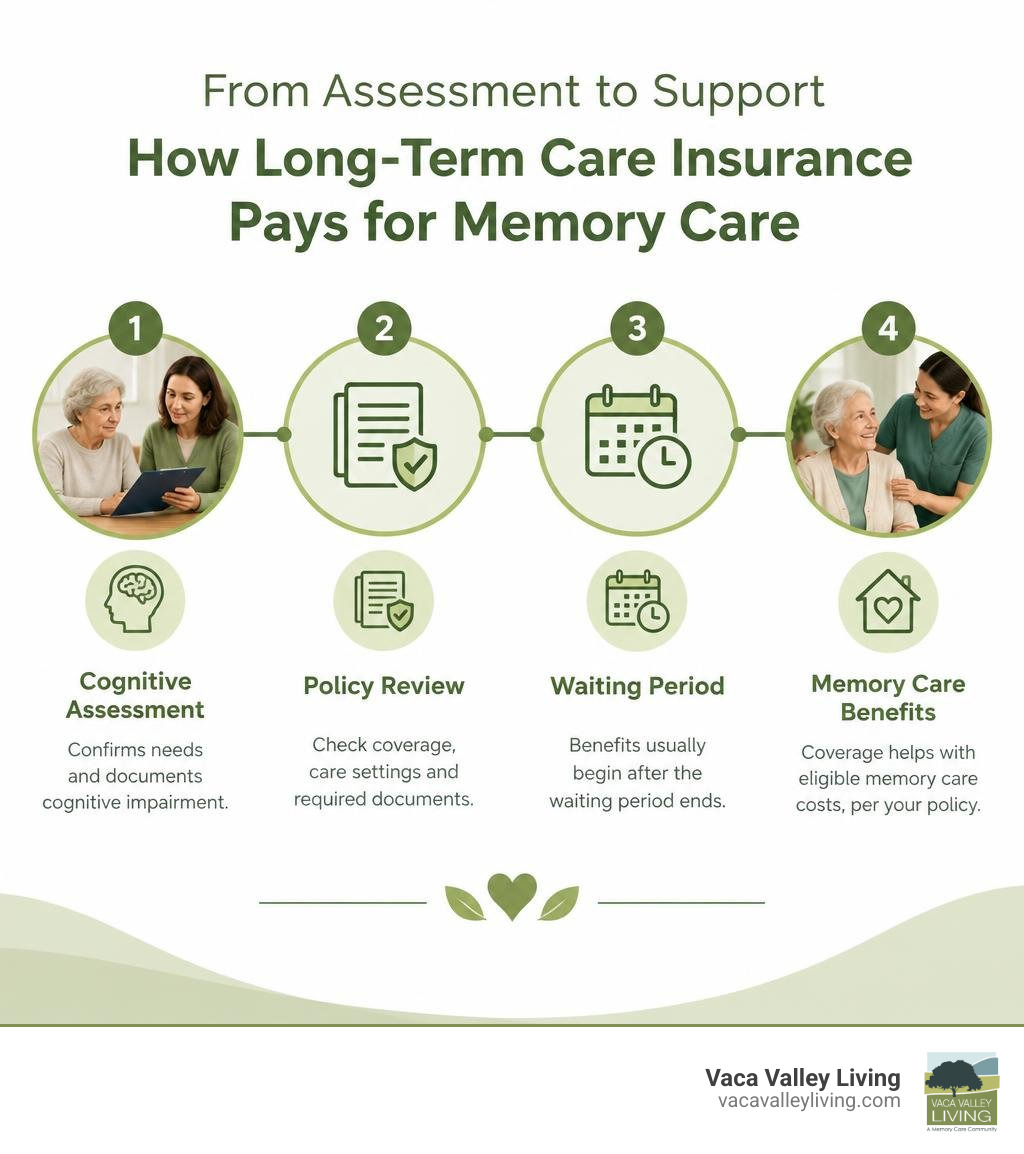
To use long term care insurance for memory care, first check whether your parent’s policy covers their care setting. A dementia diagnosis alone may not start payments. The insurer may also require proof that your parent needs substantial supervision because of cognitive impairment. Benefits usually begin only after the policy’s waiting period has passed.
If you already have a policy, call the insurer and ask what documents it needs, which memory care costs it covers, and when the waiting period starts. That gives your family a clearer picture of what you may need to pay while arranging safe, reliable care.
How Long Term Care Insurance for Memory Care Works and What It Covers

Navigating long-term care insurance can feel daunting, especially when managing the emotional weight of a loved one's cognitive decline. According to the National Council on Aging, understanding policy details is essential to maximize your benefits; you can consult the NCOA guide on LTC insurance and memory care for an in-depth breakdown of standard coverage structures.
At its core, long-term care insurance is designed to cover non-medical custodial care—the type of help people need with day-to-day activities when they can no longer live independently. Unlike standard health plans that only pay for acute medical interventions, a comprehensive LTC policy bridges the gap between basic medical needs and daily living support.
Policies typically operate on one of two reimbursement models:
- Reimbursement Model: The family pays out-of-pocket for qualified care services, submits the itemized receipts and care notes to the insurer, and receives reimbursement up to the daily or monthly limit.
- Cash Indemnity Model: Once eligibility criteria are met, the insurer pays a fixed monthly cash benefit directly to the policyholder, regardless of actual expenses incurred, offering maximum flexibility for family-directed care arrangements.
Covered Expenses: Custodial Support, Room and Board, and Memory Care Services
When families ask what is a memory care facility, they often want to know whether a policy will pay for the total monthly invoice or only specific medical items. In most comprehensive LTC policies, covered expenses include:
- Room and Board: The residential living costs within a licensed memory care community, including private or semi-private suites, utilities, and daily meals.
- Custodial Care: Hands-on assistance with Activities of Daily Living (ADLs), such as dressing, bathing, eating, toileting, transferring, and personal hygiene.
- Specialized Supervision: 24-hour monitoring by trained staff to prevent wandering, manage behavioral changes, and maintain a secure environment.
- Therapeutic Programming: Cognitive stimulation, music therapy, sensory activities, and exercise programs structured specifically for dementia.
Managing the monthly dementia assisted living cost becomes much more predictable when you know exactly which portion of the provider's bill qualifies for direct policy payouts.
Benefit Triggers and Elimination Periods in Long Term Care Insurance for Memory Care
Before an insurer releases a single dollar, two conditions must be satisfied: a benefit trigger and the elimination period.
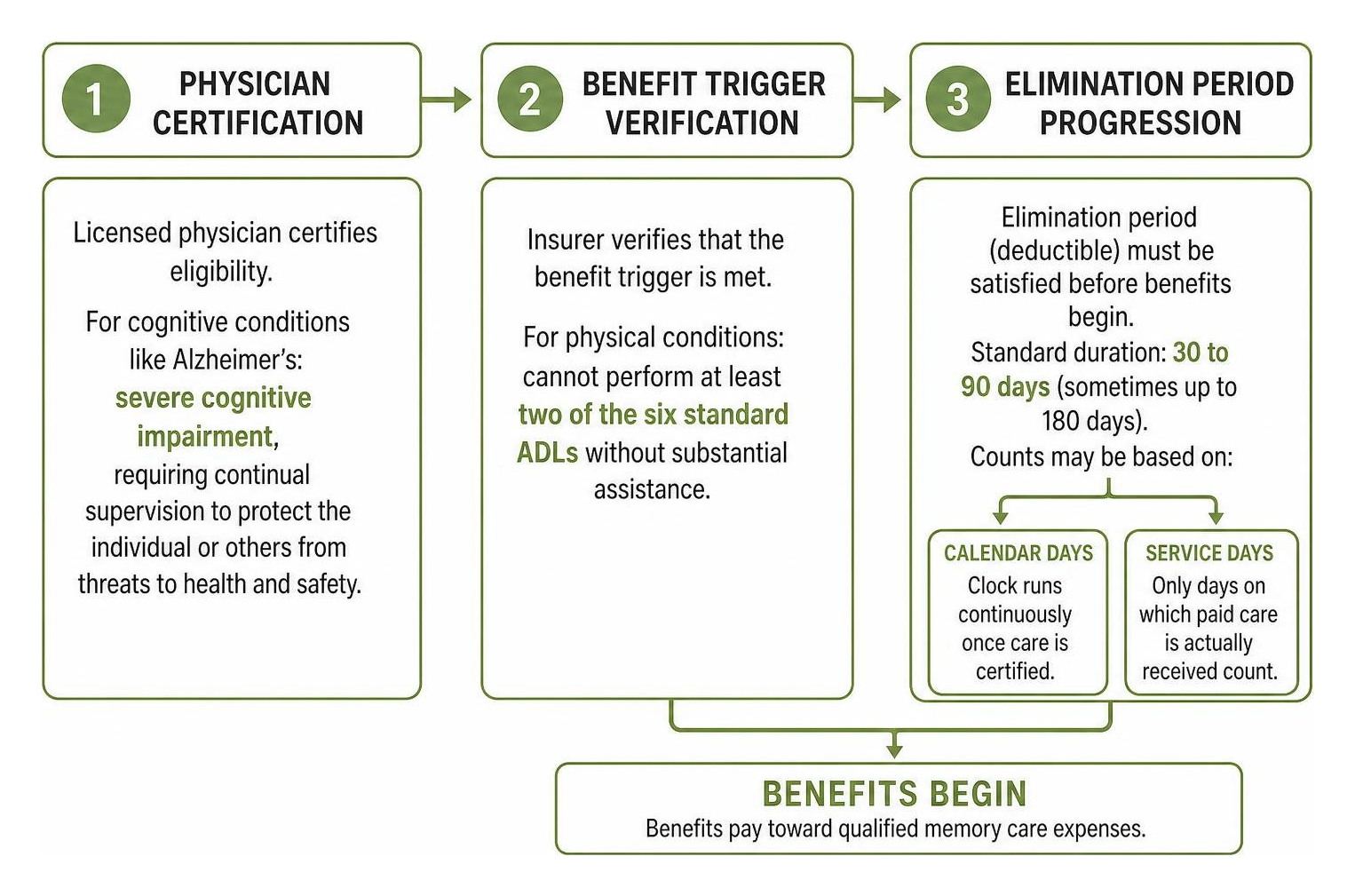
- Benefit Triggers: For physical conditions, policies typically require a licensed physician to certify that the individual cannot perform at least two of the six standard ADLs without substantial assistance. For cognitive conditions like Alzheimer's, the trigger is severe cognitive impairment, requiring continual supervision to protect the individual or others from threats to health and safety.
- Elimination Period: Think of this as the deductible measured in days rather than dollars. Standard elimination periods range from 30 to 90 days (and sometimes up to 180 days). During this waiting window, you must pay all care costs out of pocket.
It is vital to check whether your policy counts calendar days (where the clock runs continuously once care is certified) or service days (where only days on which paid care is actually received count toward the requirement). Once these milestones are met, benefits begin paying out toward residential memory care expenses.
Comparing Insurance Types: Why Standard Health and Disability Fall Short

Families often assume their existing health or disability coverage will handle cognitive care needs, only to face unexpected out-of-pocket bills. The California Department of Insurance LTC guide notes that traditional health insurance plans are strictly designed for curative medical treatment, not extended custodial support.
Health, Disability, and Life Insurance vs. Long-Term Care
Understanding how these policy types differ is critical when building a long-term care plan. To review the distinct roles of wage-loss versus care-cost protection, see this Disability Insurance vs. Long-Term Care Insurance comparison.
| Policy Type | Primary Purpose | Benefit Trigger | Covers Memory Care Custodial Costs? |
|---|---|---|---|
| Health Insurance / Medicare | Acute medical treatment, doctor visits, hospitalizations | Medical necessity, illness, injury | No (Only covers medical visits, diagnostic tests, and limited short-term skilled rehab) |
| Long-Term Disability (LTD) | Replaces lost income during working years | Inability to work in one's occupation due to disability | No (Pays cash income to the worker, but coverage typically terminates at age 65) |
| Traditional Long-Term Care | Reimburses daily custodial and residential care costs | Inability to do 2 ADLs or severe cognitive impairment | Yes (Covers room, board, and specialized memory supervision up to policy maximums) |
| Hybrid Life / LTC Policy | Provides care pool while alive; leaves death benefit if unused | Inability to do 2 ADLs or severe cognitive impairment | Yes (Accelerates death benefit to fund monthly memory care costs) |
Disability insurance protects your paycheck while you work, but the median age for entering long-term care is in the late 70s—creating a multi-year coverage gap if you rely solely on employer disability plans.
Traditional vs. Hybrid Long Term Care Insurance for Memory Care
Traditional stand-alone LTC policies operate like auto insurance: you pay ongoing premiums, and if you never need care, the premiums are retained by the insurer. In addition, older traditional policies sometimes faced rate increases over time.
In response, the insurance market introduced hybrid policies (also called asset-based policies or life insurance with long-term care riders). A hybrid policy links long-term care coverage to a whole or universal life insurance asset:
- If you need care: The policy accelerates the death benefit to pay for qualified memory care services.
- If you never need care: A tax-free death benefit passes directly to your beneficiaries.
- Premium guarantees: Hybrid policies lock in fixed premium schedules, protecting families against unexpected rate hikes down the road.
Can You Buy Coverage After a Dementia Diagnosis? Timing and Policy Underwriting
A frequent question families ask is whether they can purchase coverage once mild cognitive impairment (MCI) or early-stage dementia is suspected or officially diagnosed.
Unfortunately, you cannot purchase a new long-term care insurance policy after receiving an Alzheimer's or dementia diagnosis.
Insurance is based on underwriting unknown future risks. Once a cognitive diagnosis is documented in medical records, insurers classify the applicant as uninsurable for long-term care products.
Medical Underwriting and Pre-Existing Condition Exclusions
During the application process, underwriters conduct thorough reviews:
- Ordering complete medical histories and pharmacy records.
- Looking for prescriptions related to memory enhancement (such as donepezil or memantine).
- Administering brief cognitive screenings (such as word-recall or clock-drawing assessments) for applicants over age 50.
- Checking for lookback clauses regarding undisclosed symptoms or physician notes.
If you are planning ahead, the ideal window to apply for coverage is between ages 50 and 65, while your general health is strong and no cognitive decline has been recorded.
What Determines Policy Premiums: Age, Gender, and Health Status
Premiums are calculated using several baseline factors:
- Age: Younger applicants secure substantially lower monthly rates. A 55-year-old man might pay around $900 annually for $165,000 in baseline coverage, whereas waiting until age 65 can more than double that premium.
- Gender: Because women live longer on average (needing care for an average of 3.7 years compared to 2.2 years for men), women pay roughly 50% to 70% more for identical individual coverage (about $1,500 annually for a 55-year-old woman for $165,000 in coverage). Couples can often mitigate this by purchasing joint hybrid policies.
- Riders & Inflation: Adding compound inflation protection increases the initial premium, but ensures a $150 daily benefit chosen today grows to keep pace with future living costs. If you are assessing the balance between insurance and personal reserves, examine these self-funding long-term care considerations to see how healthcare inflation affects private wealth.
Reviewing an Existing Policy for Dementia: Key Questions and Checklist
If your family already owns a legacy policy, do not assume all memory care expenses are handled identically. Take time to audit the policy documents carefully using the checklist below.
Verifying Alzheimer's Coverage, Daily Benefit Maximums, and Inflation Riders
Older policies written in the 1980s or 1990s sometimes included vague language excluding "mental and nervous disorders." However, modern regulations clarify that organic brain disorders, including Alzheimer's disease and other forms of dementia, must be covered.
Verify the daily benefit cap. If a policy pays a maximum of $150 per day ($4,500 monthly) and placement in a dedicated dementia care community costs $7,000 monthly, your family must plan to cover the remaining $2,500 per month from personal savings or other income sources.
State Partnership Programs and Asset Protection for Medicaid
Many states offer Long-Term Care Partnership Programs designed to encourage people to purchase private insurance while offering a safety net:
- Dollar-for-Dollar Asset Protection: For every dollar your partnership-qualified policy pays out in valid long-term care benefits, you can protect a dollar of personal assets from the standard Medicaid asset spend-down limits.
- Estate Recovery Exemption: Those protected assets are also shielded from state Medicaid estate recovery after the policyholder passes away, allowing you to preserve an inheritance for your family while still accessing state-supported care if private benefits run out.
Alternatives and Practical Financial Planning When You Cannot Get LTC Insurance
If obtaining new coverage is no longer an option, practical strategies exist to fund high-quality memory care without exhausting your family's financial stability. Exploring options for dementia care financial assistance early on can prevent financial emergencies.
Government Programs: Medicare, Medicaid, and Veterans Benefits
- Medicare: Medicare covers acute medical needs, physician visits, and limited short-term rehabilitation in a skilled nursing facility (up to 100 days following a qualifying three-day inpatient hospital stay). It does not pay for monthly room and board or ongoing custodial memory care.
- Medicaid: Jointly funded by federal and state governments, Medicaid covers custodial care in certified nursing facilities and, in some areas, through home-and-community-based waiver programs for low-income seniors who meet strict asset and medical criteria.
- Veterans Benefits (Aid and Attendance): Wartime veterans and their surviving spouses who require the assistance of another person for daily activities may qualify for the VA Aid and Attendance pension benefit, providing monthly tax-free cash to help cover memory care facility costs.
Self-Funding Strategies, Life Settlements, and Care Navigation
- Health Savings Accounts (HSAs): Funds saved in an HSA roll over year after year and can be withdrawn 100% tax-free to pay for qualified long-term custodial medical care expenses.
- SECURE Act 2.0 Provisions: Qualified individuals can make penalty-free distributions from certain retirement plans to pay for qualified long-term care insurance premiums up to annual statutory limits.
- Life Settlements & Accelerated Death Benefits: If the individual holds an existing standard life insurance policy, check if it contains a chronic illness rider. Alternatively, the policy can sometimes be sold through a life settlement for a lump sum higher than the cash surrender value.
- Home Equity Conversion: A reverse mortgage (HECM) or bridge loan can unlock equity in the family home to finance monthly care community fees while preserving other investment portfolios.
Frequently Asked Questions About Long-Term Care and Dementia
Does Medicare cover memory care facility costs?
No. Medicare does not pay for custodial room and board or non-medical 24-hour supervision in a residential memory care community. It only covers medically necessary treatments, doctor evaluations, physical therapy, and hospice care.
What is the average monthly cost of memory care in 2026?
According to proprietary senior care industry data, the national average cost for a specialized memory care community is approximately $6,999 per month. Actual monthly rates vary based on location, suite style, and the level of hands-on physical assistance required.
How does an elimination period work for someone with dementia?
An elimination period is the required waiting timeframe (typically 30 to 90 days) between the date a physician certifies the cognitive impairment trigger and the date insurance benefit payments actually begin. During this period, the family or policyholder must pay all care costs out of pocket.
Conclusion
Securing the right care for a loved one with dementia requires balancing medical needs, physical safety, and financial resources. Understanding how long-term care insurance activates—and recognizing its benefit triggers, waiting periods, and payout structures—allows your family to make informed choices with confidence.
At Vaca Valley Living, we provide compassionate, residential memory care for seniors with Alzheimer's and dementia throughout Vacaville, Suisun City, and neighboring communities. As a family-owned community with over 50 years of senior care experience, we offer 24-hour staffing, personalized care plans, on-site salon amenities, and dedicated transportation in a warm, home-like environment. We are here to help you navigate your family's care options every step of the way.