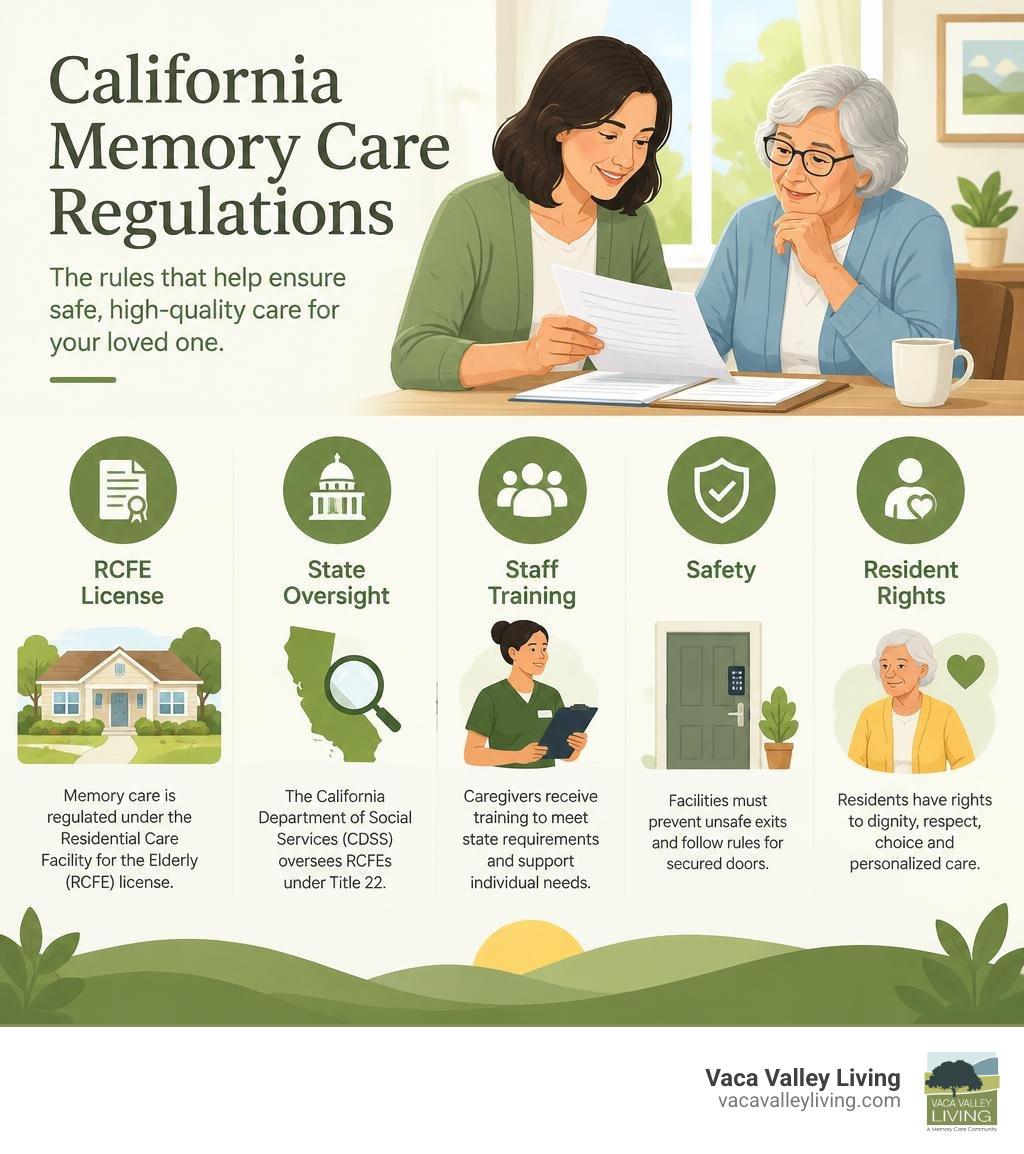
What California Memory Care Regulations Mean for Your Family
California memory care regulations apply through the Residential Care Facility for the Elderly (RCFE) license, the same license used for assisted living. “Memory care” is not a separate state license. The California Department of Social Services oversees RCFEs under Title 22 rules covering care, staff training, safety, and resident rights.
Rules effective January 1, 2025, put more focus on each resident’s needs and behaviors, not just a dementia diagnosis. If you’re choosing care for a parent, start by checking the facility’s license and inspection history. Then ask how staff are trained, how the home prevents unsafe exits, and what consent it requires for secured doors.
Understanding California Memory Care Regulations and Licensing Framework
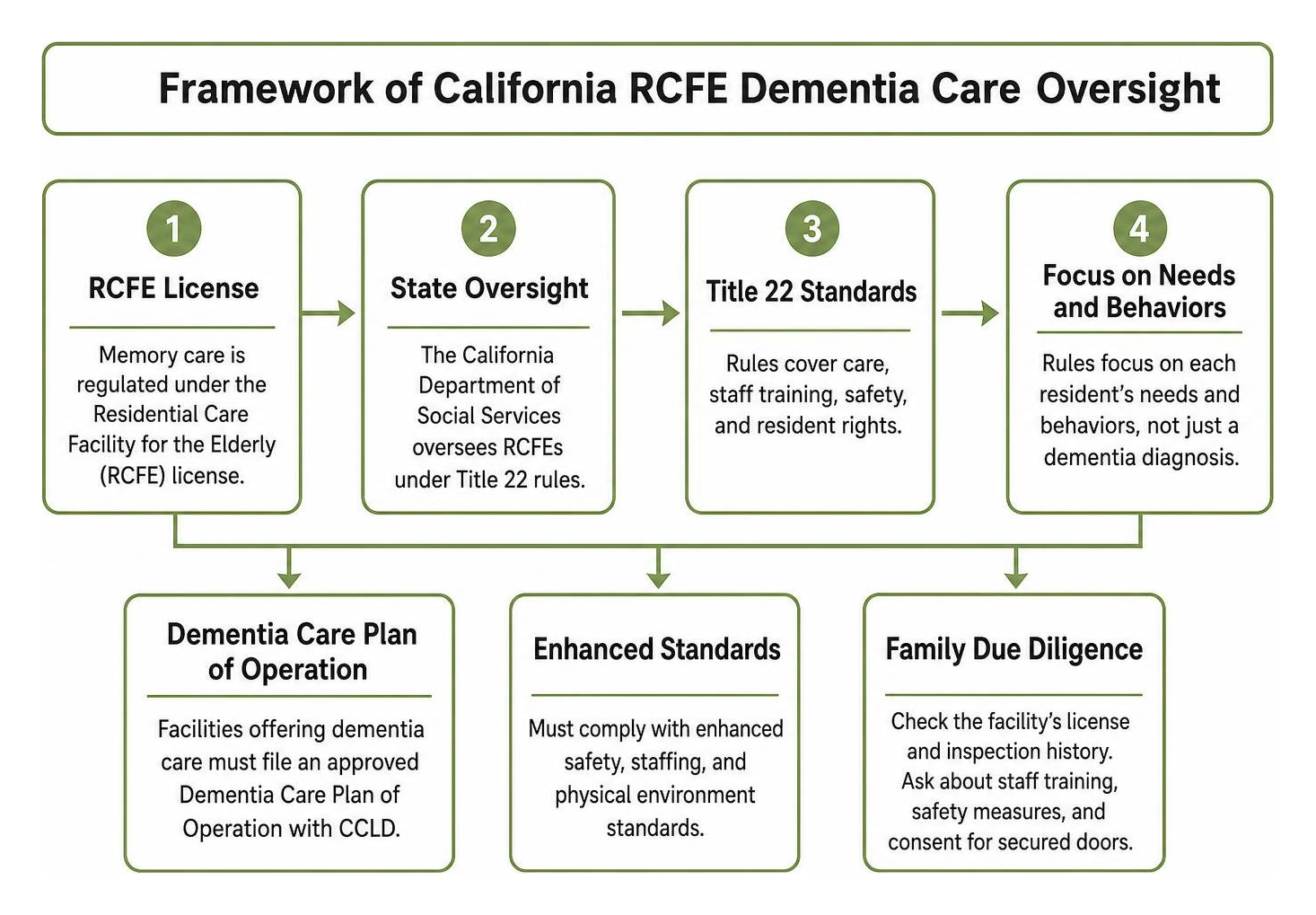
When families begin researching senior living, they often expect "memory care" to be an entirely distinct category of state license. In California, it is actually regulated under the broad framework governing Residential Care Facilities for the Elderly (RCFEs). The California Department of Social Services (CDSS) Community Care Licensing Division (CCLD) enforces these standards through Title 22 of the California Code of Regulations.
To review the legal foundation of these facilities, you can read this overview of California RCFE licensing standards. Understanding how state law classifies residential elder care helps clarify what services are provided.
An RCFE provides non-medical residential care, personal assistance, meal preparation, housekeeping, activity coordination, and medication distribution for adults aged 60 and older. Because "memory care" is a marketing term rather than a standalone license, any community advertising specialized dementia care must file an approved Dementia Care Plan of Operation with CCLD and comply with enhanced safety, staffing, and physical environment standards.
Families exploring care options often wonder what is a memory care facility within this legal landscape. Put simply, it is a licensed RCFE that has met state benchmarks to safely support individuals living with progressive cognitive impairment.
Key Updates to Dementia Care Rules and Medical Assessments
Significant regulatory changes took effect across California on January 1, 2025. Rather than confining dementia requirements to an isolated chapter, the state integrated dementia care standards across multiple sections of Title 22.
The central philosophy of these updates is a transition from diagnosis-based management to person-centered behavioral care. Under California Title 22 Section 87705 dementia regulations, facilities must evaluate and respond to the unique behavioral expressions of each resident, recognizing that cognitive impairment affects everyone differently.
Environmental safety rules were also modernized:
- Slip-Resistant Flooring: Outdated language referencing "nonskid" surfaces was updated to require certified slip-resistant flooring, strips, or mats in all showers and bathtubs, maintained in safe condition.
- Waste Management: Daily waste container emptying and sanitation protocols are required to uphold infection control and hygiene standards.

Updated Medical Assessments and the LIC 602A Form
Admission to an RCFE requires a comprehensive pre-placement medical assessment signed by a licensed physician. To align with the 2025 updates, the state revised the standard LIC 602A form in April 2025.
The updated form requires physicians to document specific behavioral observations, emotional patterns, and cognitive changes rather than merely checking a box for Alzheimer's or related conditions. This detailed clinical evaluation helps families and providers determine what stage of dementia is memory care necessary for, ensuring the community's staff can safely accommodate the senior's daily living requirements.
Instead of enacting blanket restrictions, providers must conduct individualized assessments to determine whether access to household items (such as personal toiletries or craft scissors) poses a genuine hazard to that specific resident.
Firearm Policies and Facility Admission Agreements
Under California Health and Safety Code Section 1569.282, strict rules govern firearms in residential senior care environments. RCFEs must establish written firearm policies within their standard admission agreements.
If any resident retains a firearm, it must be locked, unloaded, and stored in compliance with state law to safeguard all residents, staff, and visitors. Admission agreements must explicitly outline these retention and storage restrictions before move-in.
Safety Standards, Security Devices, and Staffing Mandates
California mandates that RCFEs provide 24-hour staffing to meet resident needs. While Title 22 does not prescribe a rigid, universal staff-to-resident mathematical ratio, it requires "sufficient" direct-care staff on duty at all times.
For smaller communities licensed for fewer than 16 beds, state rules require at least one awake direct-care staff member on duty throughout the night whenever any resident's appraisal identifies a need for awake overnight supervision.
Facilities must also maintain comprehensive liability insurance coverage of at least $1,000,000 per occurrence and $3,000,000 in aggregate. Under Senate Bill 582, RCFEs must submit their disaster and emergency plans directly to their local Medical Health Operational Area Coordinator (MHOAC), ensuring seamless coordination with first responders during regional emergencies or natural disasters.
How California Memory Care Regulations Govern Secured Perimeters and Elopement
Wandering is a frequent symptom of memory loss, but facilities cannot simply lock residents inside without strict regulatory compliance. California memory care regulations establish specific legal protocols before a community can secure its perimeter or install delayed egress devices:
- Fire Marshal Clearance: Any locking mechanism or delayed egress system (doors that remain locked for 15 to 30 seconds upon being pushed before releasing) must be formally approved by the local fire authority.
- State Licensing Notification: The community must formally notify CCLD of the installation and operational plan for all egress-control systems.
- Informed Consent: A resident cannot be placed behind locked doors without signed voluntary consent or explicit authorization from a legally appointed conservator.
- Auditory Perimeter Alarms: Exterior gates and doors must use functional auditory alert systems to inform staff whenever an exit point is opened.
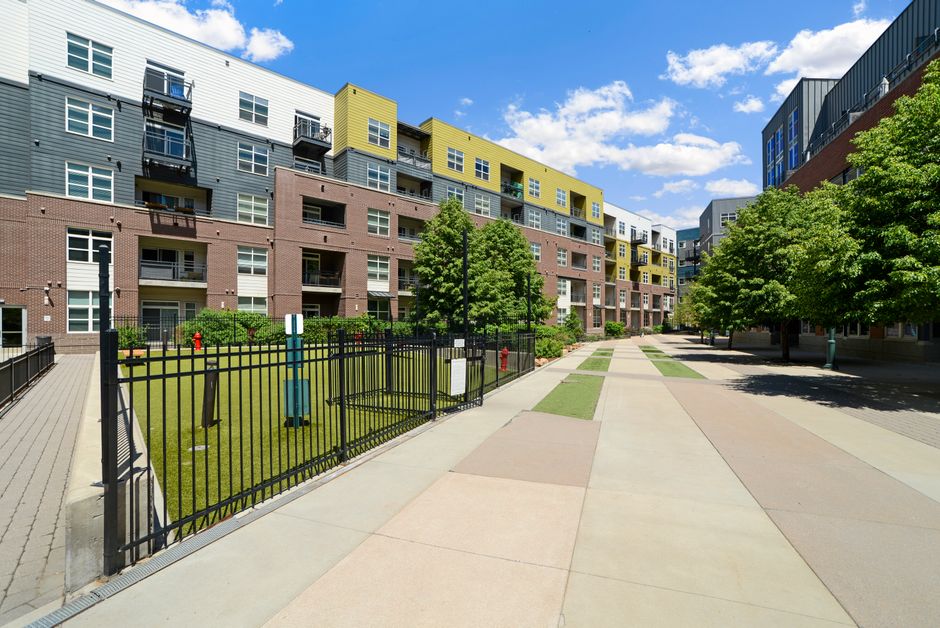
Exploring purposeful memory care safety features shows how built-in architecture preserves autonomy while preventing unsafe wandering. A thoughtfully designed secure memory care unit gives seniors access to outdoor courtyards and open living spaces without exposing them to street hazards.
If an elopement occurs (a resident leaves the facility unsupervised), state rules require the provider to notify the resident's designated family representative immediately. The community must also file an official report with the CCLD licensing officer by telephone, email, or fax no later than the next business day.
Staff Training Mandates Under California Memory Care Regulations
Direct-care staff in California RCFEs must complete thorough education before and during their employment:
- Initial Training: Direct-care personnel must receive 12 hours of specialized dementia care training within their first four weeks on the job, with at least 6 hours completed prior to working independently with residents.
- Annual Continuing Education: Direct-care staff must complete at least 8 hours of dedicated dementia training every year thereafter (as part of their required 20 hours of annual training).
This curriculum covers essential topics such as hydration, nutrition, skin breakdown prevention, non-verbal communication, therapeutic behavioral techniques, and safe memory care medication management. This training helps every dementia care community deliver compassionate care grounded in person-first methodologies.
Memory Care Costs, Medi-Cal, and State Financing Programs
Navigating senior living expenses requires planning. In California, standard assisted living averages approximately $7,000 per month (compared to a national median of roughly $6,200).
Because memory care requires higher staffing levels, dedicated security measures, and specialized programming, monthly fees generally range from $5,000 to over $10,000 depending on the location and level of care required.
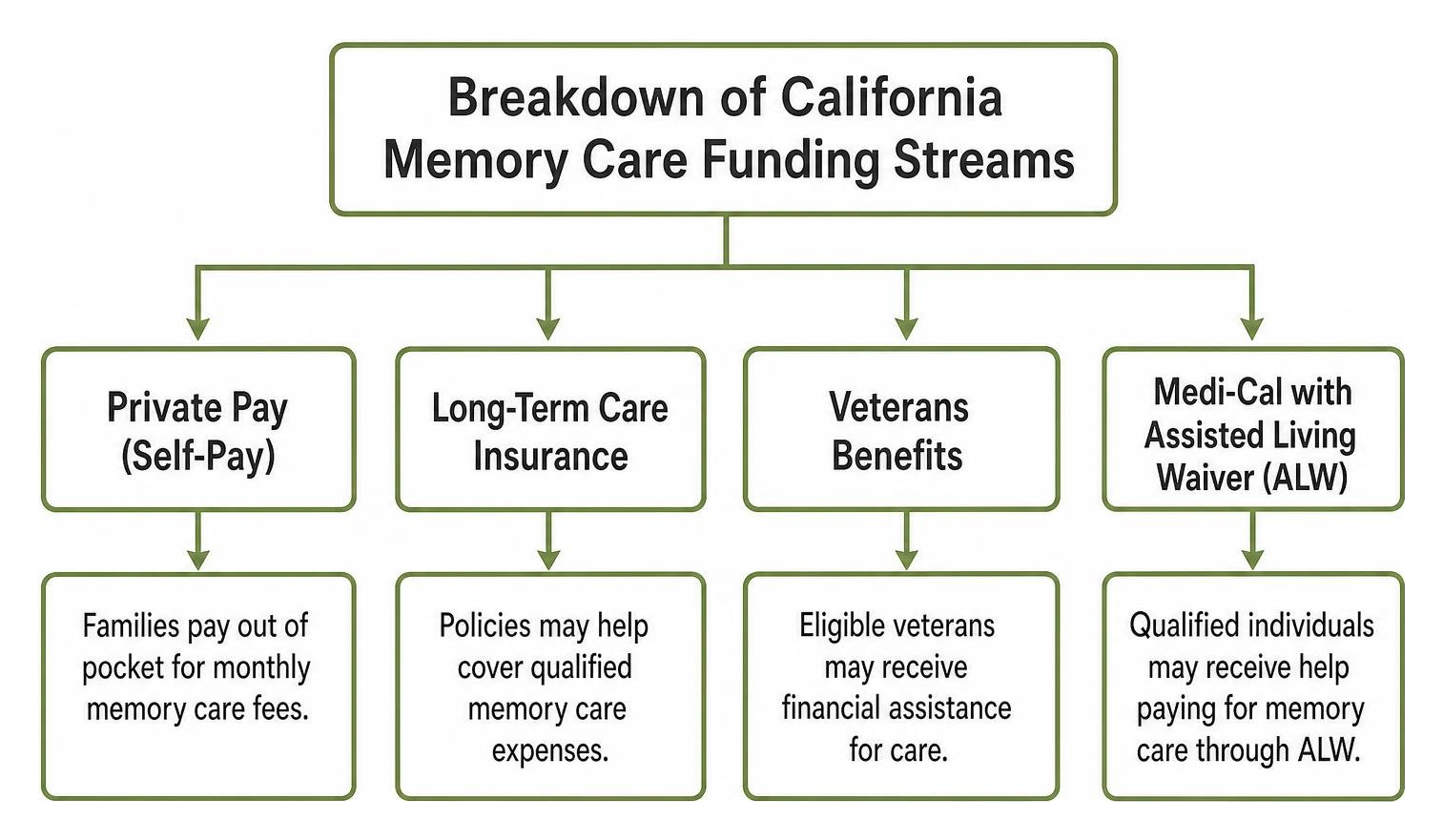
Families should clarify whether a prospective community uses an all-inclusive flat pricing model or a tiered structure where monthly fees increase as personal care needs expand. For specialized care, families often select dedicated residential memory care programs that outline service levels clearly.
Medi-Cal and the Assisted Living Waiver (ALW)
A common misconception is that standard Medi-Cal pays for room and board in assisted living or memory care. Medi-Cal never covers room and board costs in an RCFE.
However, the Assisted Living Waiver (ALW)—authorized through 2029—can reimburse eligible participants for personal care and supportive services. The resident remains responsible for paying their own room and board, which low-income seniors often cover using their Supplemental Security Income/State Supplementary Payment (SSI/SSP).
The ALW program operates under distinct limitations:
- Geographic Availability: The waiver is restricted to 15 California counties: Alameda, Contra Costa, Fresno, Kern, Los Angeles, Orange, Riverside, Sacramento, San Bernardino, San Diego, San Francisco, San Joaquin, San Mateo, Santa Clara, and Sonoma.
- Waitlists: Enrollment slots are capped by the state, leading to waitlists and application backlogs. Families should begin the waiver assessment process as early as possible.
How to Vet a Memory Care Facility in California
Selecting a memory care community requires careful due diligence. California maintains public records of all licensed RCFE facilities, giving families clear visibility into an operator's compliance history.
Use these practical steps when vetting a prospective community:
- Search the CDSS Facility Database: Visit the Community Care Licensing Division portal to look up the facility's license number, operational status, and inspection history over the preceding 3 to 5 years.
- Review Citations and Deficiencies:
- Type A Citations: These represent immediate risks to resident health, safety, or legal rights (such as an unwitnessed elopement or severe medication omission).
- Type B Citations: These represent technical or non-immediate regulatory violations that could cause harm if left uncorrected (such as incomplete staff training logs or maintenance delays).
- Inspect the Physical Setting: Look for functional delayed egress systems, clear line-of-sight hallways, secure outdoor courtyards, and slip-resistant bathrooms.
- Tour Unannounced During a Mealtime: Observe how many caregivers are actively present in the dining room and how patiently they assist residents with eating and hydration.
- Examine the Admission Agreement: Verify rate-lock policies, notice periods for fee increases (California law mandates a 60-day written notice for general rate changes), and any criteria that would require a resident to move out.
Learning about our comprehensive memory care services can help you formulate specific questions when touring prospective communities.
Frequently Asked Questions About California Memory Care Regulations
Is memory care a separate license category in California?
No. Memory care is provided under the standard Residential Care Facility for the Elderly (RCFE) license administered by the CDSS Community Care Licensing Division. To provide specialized dementia services, an RCFE must submit and receive state approval for a comprehensive Dementia Care Plan of Operation.
Can a memory care community lock its exterior doors without consent?
No. A licensed RCFE cannot lock its perimeter or utilize delayed egress exit doors without meeting specific state requirements. These include obtaining local fire department clearance, notifying CCLD, and securing written voluntary consent from the resident or authorization from a legal conservator.
What are the reporting rules for an elopement incident?
If a resident leaves a facility without staff awareness, the community must immediately notify the resident's designated legal representative or family. The facility is also legally required to submit a formal incident report to the CCLD licensing agency by telephone, fax, or email no later than the next business day.
Conclusion
Navigating memory care licensing, staffing rules, and safety statutes ensures your family can choose a secure, compassionate home for your loved one. State regulations under Title 22 are designed to protect senior dignity, maintain physical safety, and guarantee transparency.
At Vaca Valley Living in Vacaville, California, we bring over 50 years of family-owned experience to senior living. Serving families throughout Vacaville, Fairfield, Dixon, and surrounding Northern California communities, we provide 24-hour staffing, personalized care plans, and an engaging, home-like setting.
Explore personalized memory care at Vaca Valley Living to discover how our community upholds California's care standards while treating your family like our own.