
Examine the Data: Key Statistics for Dementia Patients in Nursing Facilities
Dementia Patients in Nursing Homes Statistics: The Big Picture
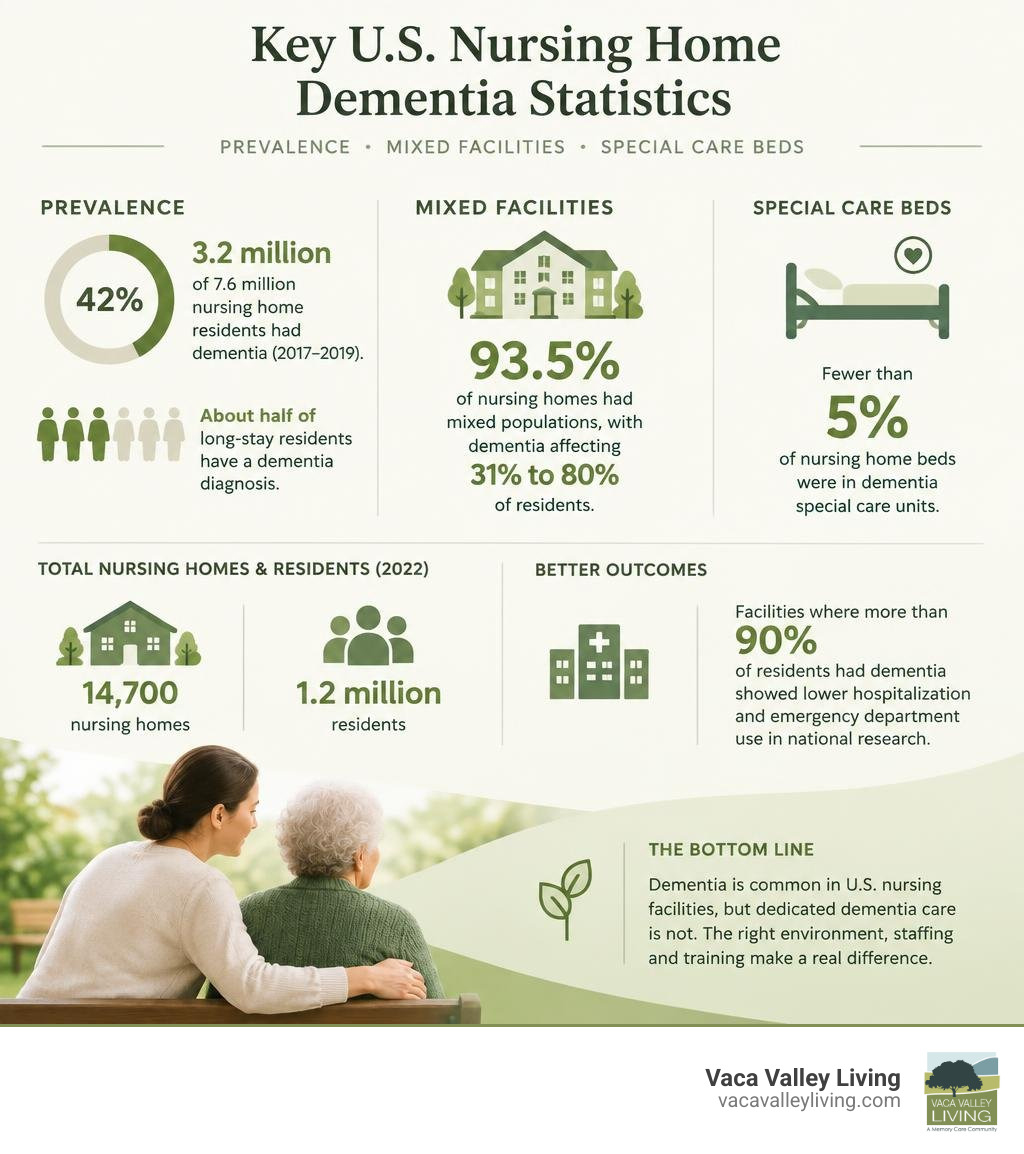
Here is the clearest takeaway: dementia is common in U.S. nursing facilities, but dedicated dementia care is not. Between 2017 and 2019, 3.2 million of 7.6 million nursing home residents - 42% - had Alzheimer's disease, related dementias, or cognitive impairment. About half of long-stay residents have a dementia diagnosis.
Key dementia patients in nursing homes statistics also show a gap families should understand:
- The United States had about 14,700 nursing homes and 1.2 million residents in 2022.
- 93.5% of nursing homes had mixed populations, with dementia affecting 31% to 80% of residents.
- Fewer than 5% of nursing home beds were in dementia special care units.
- Facilities where more than 90% of residents had dementia showed lower hospitalization and emergency department use in national research.
For families, the numbers are a starting point, not a final answer. A safe, compassionate setting depends on daily staffing, staff consistency, dementia-specific training, and whether the environment supports changing cognitive needs.
Essential Dementia Patients in Nursing Homes Statistics You Should Know
Navigating senior living options requires understanding how memory conditions shape care needs across the long-term care continuum. When cognitive changes occur, an individual's care demands evolve rapidly, requiring adjustments to daily routines, physical safety measures, and medical oversight.
Dementia Patients in Nursing Homes Statistics on Prevalence and Diagnosis
Cognitive impairment touches a major share of individuals requiring residential assistance. According to clinical datasets, roughly 42% of all unique individuals residing in nursing facilities have documented Alzheimer's disease, a related dementia, or measurable cognitive impairment. Among individuals requiring extended care—the long-stay census—this figure rises to approximately 50%. Furthermore, broader epidemiological data indicates that nearly 70% of Americans diagnosed with dementia will ultimately receive end-of-life care in a nursing home setting.
Intervening early makes a measurable difference in quality of life. Exploring options for early stage dementia care allows families to establish supportive routines and structured environments before complex behavioral symptoms emerge. As detailed in the 2025 Alzheimer's disease facts and figures report, progressive neurodegenerative conditions often manifest as mixed dementias—with over 80% of post-mortem evaluations revealing multiple underlying neuropathologies—reinforcing why comprehensive clinical tracking is essential.
Facility Distribution: Specialized Units vs. Mixed Populations
While memory care needs are widespread, the distribution of individuals living with dementia across the nation's 14,700 nursing homes is uneven. Rather than being grouped into specialized memory care environments, most residents live in facilities with heterogeneous populations:
- Mixed-Census Distribution: Approximately 93.5% of U.S. facilities maintain a mixed census where residents with dementia represent between 31% and 80% of the overall population.
- High-Concentration Settings: Only 4.1% of facilities (about 578 homes nationwide) cater predominantly to memory care, maintaining a dementia census exceeding 80%.
- Dedicated Unit Scarcity: Dedicated Dementia Special Care Units (SCUs) account for fewer than 5% of total nursing home beds nationwide, despite housing nearly three-quarters of all specialized medical beds.
Market dynamics have also shifted over recent years. As documented in research on assisted living capacity and nursing home dementia prevalence, an expansion in residential care options has enabled many individuals with mild-to-moderate impairment to reside in community-based residential care or specialized assisted living prior to requiring skilled nursing environments.
Clinical Outcomes and Specialized Dementia Care Units (SCUs)
The structure of a facility's physical and clinical environment directly impacts adverse event rates, behavioral stability, and avoidable hospital visits.
Impact of Dementia Special Care Units on Adverse Events
Placement in a specialized care setting changes resident outcomes. In conventional, mixed-population settings, staff may struggle to manage wandering, communication barriers, or behavioral expressions, often leading to defensive medical management.
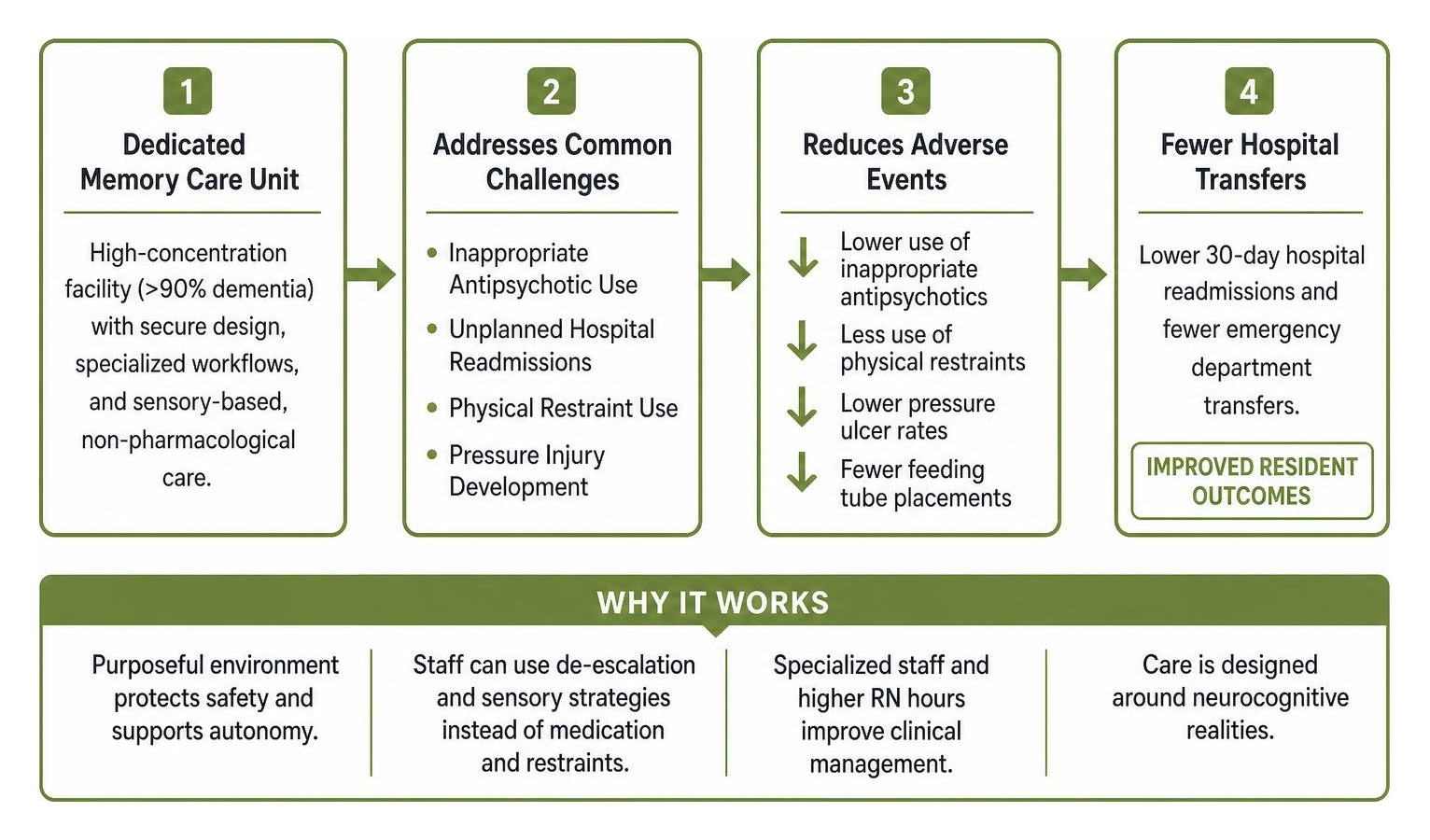
When individuals reside in a designated, secure setting, adverse events drop considerably. Research shows that dedicated dementia units significantly reduce the use of inappropriate antipsychotic medications, decrease the use of physical restraints, lower pressure ulcer rates, and reduce feeding tube placements. Recognizing what stage is aggression in dementia helps care teams implement sensory modifications and de-escalation rather than relying on pharmacological sedation. Moving into a dedicated secure memory care unit provides purposeful architectural design, such as continuous walking paths and secured exits, that protects individuals prone to wandering while preserving personal autonomy.
Concentration Thresholds and Hospitalization Rates
Clinical evidence demonstrates a clear threshold effect regarding dementia concentration. Facilities where more than 90% of the resident census comprises individuals with cognitive impairment show significant improvements in acute care metrics, including lower 30-day hospital readmissions and fewer emergency department transfers.
| Care Environment Metric | Mixed-Population Facilities (31%–80% Dementia) | High-Concentration Facilities (>90% Dementia) |
|---|---|---|
| Dementia Special Care Unit Availability | Approximately 13% – 20% | Up to 35% |
| Hospital Transfer & ED Admission Rates | Baseline to elevated | Significantly reduced |
| Direct Care RN Hours Per Resident-Day | Standard baseline | Elevated skilled nurse ratio |
| Inappropriate Antipsychotic Prescriptions | Higher reliance | Lower reliance / non-pharmacological focus |
As highlighted in a national analysis of dementia care in US nursing homes, facilities focused almost exclusively on cognitive care design their workflows, dining experiences, and activity schedules around neurocognitive realities, resulting in measurable clinical advantages.
Staffing Realities: Hours, Stability, and Specialized Training
Adequate direct-care staffing represents the cornerstone of safe long-term care, but total hours alone do not guarantee high-quality dementia support.
Analyzing Staffing Ratios and Stability
Federal Payroll-Based Journal (PBJ) records reveal typical direct-care staffing allocations across standard skilled nursing facilities:
- Registered Nurse (RN) Hours: Average approximately 0.39 hours per resident-day (HPRD).
- Certified Nurse Aide (CNA) Hours: Average roughly 2.1 HPRD.
A comprehensive study on dementia, nurse staffing, and health outcomes demonstrated that while increasing RN and CNA hours improves outcomes across all facility types, increasing hours without altering care techniques leaves significant quality gaps unresolved. Furthermore, nurse turnover and schedule instability can disrupt routine-dependent residents, triggering anxiety and confusion.
The Critical Need for Specialized Dementia Training
Direct-care staff need specific skills to care for residents with neurodegenerative diseases. Training in non-verbal communication, understanding unspoken cues, and validating emotional realities helps prevent care resistance during daily activities like bathing and dressing.
Integrating comprehensive dementia support services into daily operations creates predictable routines, calming sensory environments, and cognitively appropriate activities. Consistent staffing teams who recognize subtle behavioral changes can address discomfort, hydration needs, or early infections before they escalate into acute medical issues.
Disparities, Payer Sources, and Ownership Models
The broader structural landscape of nursing care—including facility ownership, public reimbursement rates, and demographic variations—shapes the quality of care available to families.
Payer Mix and For-Profit vs. Non-Profit Quality Differences
Approximately 72.4% of U.S. nursing facilities operate under for-profit ownership models. Facilities with high concentrations of Medicaid-reliant residents often face reimbursement shortfalls, which can limit investments in physical plant upgrades, specialized sensory wings, and ongoing dementia-certification programs for frontline aides.
Families researching Alzheimers care facilities should evaluate beyond basic CMS Five-Star Quality Ratings. Assessing direct-care nurse retention, specific memory care training requirements, and physical security features provides a clearer view of daily care quality.
Racial, Ethnic, and Socioeconomic Access Gaps
Long-term care research reveals significant disparities across racial and socioeconomic lines:
- Elevated Incidence: Epidemiological tracking among veteran populations shows higher rates of diagnosed dementia among African American (19.4%) and Hispanic (20.7%) individuals compared to Non-Hispanic White peers.
- Diagnostic Delays: Black and Hispanic seniors frequently experience later diagnoses, entering residential facilities at more advanced stages of cognitive decline.
- Facility Segregation: Dual-eligible (Medicare and Medicaid) minority seniors disproportionately reside in under-resourced facilities with lower staffing ratios and fewer dedicated memory wings.
Accessing reliable guidance through resources like our dementia support groups guide 2026 and community Alzheimers family support networks empowers families to navigate these systemic complexities. Longitudinal data on living arrangements for persons living with dementia reinforces the importance of matching an individual's functional profile with supportive, properly resourced environments.
Policy Implications and Future Staffing Standards
The concentration of individuals with cognitive impairment in non-specialized environments highlights key areas for regulatory and policy reform:
- Case-Mix Adjusted Staffing Mandates: Federal and state minimum staffing standards must account for cognitive acuity, ensuring facilities with high dementia censuses maintain higher nurse-to-resident ratios.
- Mandatory Dementia Care Competency: Base-level CNA and nursing curricula require standardized training in non-pharmacological behavioral management and cognitive communication.
- Incentivizing Dedicated Memory Care Environments: State Medicaid programs should consider tiered reimbursement rates for providers investing in secure, certified memory care wings and specialized staffing models.
Frequently Asked Questions About Dementia in Nursing Facilities
What percentage of nursing home residents have dementia?
Approximately 42% of all individuals admitted to nursing facilities have Alzheimer's disease, a related dementia, or diagnosed cognitive impairment. Among long-stay residents requiring continuous daily care, roughly 50% carry a dementia diagnosis.
Do dedicated memory care units provide better care than standard nursing homes?
Yes. Clinical studies show that dedicated dementia special care units achieve lower rates of inappropriate antipsychotic use, fewer physical restraints, reduced pressure ulcer formation, and fewer avoidable emergency room visits compared to non-specialized, mixed-census units.
How does facility ownership affect the quality of dementia care?
While quality varies by provider, research indicates that non-profit facilities and highly specialized memory care communities generally maintain higher registered nurse staffing hours per resident-day and experience lower staff turnover than large for-profit chains heavily reliant on basic Medicaid funding.
Conclusion
The national data paints an unmistakable picture: while millions of older adults navigate cognitive impairment in long-term care settings, standard nursing facilities are often not fully equipped for specialized memory support. Optimizing comfort, safety, and personal dignity requires environments designed specifically around the cognitive and behavioral needs of memory loss.
At Vaca Valley Living, we understand that exceptional memory care requires more than standard clinical supervision. As a family-owned community in Vacaville, CA, with over 50 years of dedicated experience, we offer 24-hour specialized staffing, individualized care plans, engaging social programs, and supportive amenities within a secure, home-like setting. Explore our specialized residential memory care community to discover how personalized, compassionate care can support your loved one.